A new series highlighting the work of a gender-critical feminists throughout Asia
Get ready to be inspired and informed as I embark on a new series here on my site, “Empowering Voices: Asia’s Gender-Critical Feminists in Focus.” Throughout this series, I aim to celebrate the remarkable, and often overlooked, work of feminist activists from across Asia. It’s time to celebrate the stories that deserve to be heard and that are making a difference, one spotlight at a time. It is crucial to shed light on the extraordinary efforts and achievements of gender-critical feminists in Asia who are breaking barriers, challenging norms, and making a profound impact in their communities. Each month I hope to delve into the lives, stories, and accomplishments of these inspiring individuals, highlighting their contributions to the feminist movement and the broader social landscape. I hope you join me on this journey as I honor the resilience, courage, and determination of feminists in Asia who refuse to accept the indoctrination of gender identity ideology.
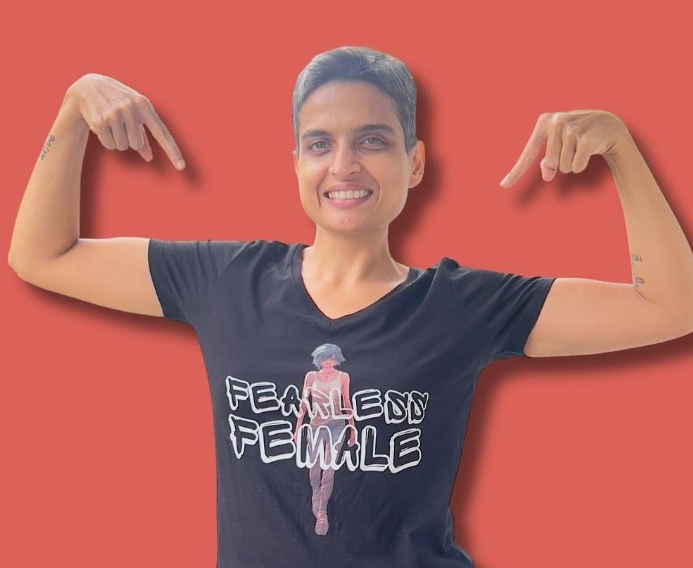
Fearless Female is epitomized in the first feminist to be featured in this series, and what an honor to know her! Vaishnavi Sundar is a woman I have admired for a long time. Her four-part series on Gender Identity Ideology and its effects on women and girls, Dysphoric: Fleeing Womanhood Like a House on Fire, had quite an impact on me and found its way into my university lectures and teaching material. At the heart of her work lies a fierce determination to challenge societal norms, dismantle stereotypes, and give voice to the marginalized who so often don’t get a voice when opposing gender identity ideology. Sundar’s unyielding commitment to the rights of women and girls is a resounding battle cry, as she exposes the pervasive lies and manipulations put out by radical genderists, forcing viewers to confront uncomfortable truths and reconsider long-held beliefs. With an unyielding dedication to truth telling, Sundar is a dynamic feminist filmmaker and activist, fearlessly challenging sexism, misogyny, and female erasure. Let me introduce you to the provocative and revolutionary world of Vaishnavi Sundar, where the power of the lens converges with the power of change.
- First, can you tell us your name and where you are based in Asia?
My name is Vaishnavi Sundar, I’m a filmmaker, writer and a feminist activist based in Chennai, a city located in the South of India.
- What was your first big project? What are some of the key feminist topics or issues that you have explored? Why did you choose to focus on these particular subjects?
I wouldn’t know how to quantify something as big, but I think purely in terms of duration, my first feature length project was But What Was She Wearing? ( BWWSW). I think it still is India’s only film on the topic of workplace sexual harassment faced by women, that deep-dives into both the organised as well as the unorganised sector. But before BWWSW, I’d already made two shorter documentaries and a couple of fiction films. In my humble filmmaking experience, I have touched upon topics of class, caste, exploitation of all forms that intersects with misogyny. I choose subjects that center women because that’s who I am. I am a woman, and I want to make films about other women; women like me, women so vastly different from me despite being tethered together as a sex class. We live in an unequal society, and sex-based oppression aside, women in India and in extension Asia, face several multilayered exploitations, violations and categorical abuse that I might die before I can make films on all the injustices. But I endeavor to do as much as I can.

- Can you tell us more about the work that you do with the organizations you have founded, Women Making Films and Lime Soda Films.
Women Making Films (WMF) is a pet project that I started in 2015 because I was overcome by the number of men I encountered while trying to make films in my city. I wanted to create a space for female filmmakers to come together. The patriarchy, misogyny and sexism in the society permeates into all industries without an exception. And through WMF, I wanted to create a forum for the promotion of female filmmakers, their work, through blogs, workshops, screenings, film festivals and mentorship programs. Even before I started WMF, I tried to bring together an all-female crew for my films. My work predates some of Hollywood’s multi-billion dollar “inclusion programmes” that still only does lip service. Ever since I started it, WMF now has members from more than 20 countries. I’m stretched thin by my film, writing, and advocacy work that I sometimes find it hard to hold film festivals and screenings. But I hope to remedy it after my current project concludes. WMF is also a repository of some great essays, reviews, and opinion pieces. I’m so proud of what it has become. PS: Anyone who is female who has at least one film to her credit as a head of any department, is welcome to sign up. Signing up is free!
Lime Soda Films is the name of my film production company. I write, produce, direct and distribute it under this banner. I founded this when I was in the process of releasing my second ever film, way back in 2014. I wanted a name that was fresh, unconventional, and curious – incidentally, these could also be the adjectives used to describe me. I also just happen to love lime soda. And just like that, I bought the domain, and it has been a glorious few years.

- Can you tell us about your journey as a gender critical filmmaker and feminist activist in India? What motivated you to combine these two roles?
I was raised in a typical Indian family where sex role stereotypes were upheld to its full capacity. I was considered a deviant from a very young age. I had short hair, loved wearing loose, cotton clothes for they were comfy, loathed dresses and such for it hindered my hyperactivity. I was born with a lot of breathing complications, so the family “allowed” my hairstyle. Thankfully, in the 1980s, gender ideology wasn’t a thing, if it was, I would have gladly given away parts of my body to flee from womanhood. This knowledge of how easily I could have been swayed into this cult affected me deeply as an adult.
I have always been an evocative storyteller, I seem to have a way with narrating things, that I often laugh to myself when I think about what I do now. But like most Indian homes, unconventional academic pursuits were frowned upon. Had they let me be, I would have probably made five dozen films by now. But I went through the rat race of business education and corporate jobs before giving it all up in 2013.
My route to redemption from a deeply entrenched patriarchal background initially came from liberal feminism. But to be fair, I didn’t know feminism of any other kind existed. While I was merrily chanting libfem slogans, two things kept bothering me: the libfem diktat to call pornography and prostitution a matter of “choice!” I started isolating myself from these groups online, trying to find resources to better understand porn and prostitution from a critical vantage point.
Also, back when I was actively creating events via WMF, I too capitulated to the woke jargon and used the phrase “identifies as women” on the website. However, I never had anyone but females signing up at that time. Imagine the crisis that would have befallen me. Sall Grover’s legal case with her company Giggle comes to mind. Anyway, it was a very innocent exchange between me and a friend of mine (a male) who candidly asked what I meant by “identify as…” and said “do you mean, men?” I think that was the moment when a light went off and I have since never looked back. A lesson here is that a lot of women mindlessly include phrases without realising the ramifications. So a lot of them are moments away from seeing it for themselves. Hopefully sooner than later.
Not that I was ever interested in gender identity politics even in my libfem days. My films have always been about women regardless of my knowledge (or should I say ignorance) on the subject. I knew I always wanted to advocate for women’s rights, and I chose to put my skill to use by making films, and using this medium as a tool for social change.
- This hasn’t been an easy journey. What are the unique challenges you face as a feminist activist and filmmaker in India, and how do you work to overcome them?
I have often wondered if I’m part of “the industry” for I feel I’m too insignificant at this stage. But it is fascinating how people move away from you the moment you go against the grain. Life has completely changed after I have been openly critical of transgender ideology but the challenges predate the current tide.
After I decided to quit my job and nosedived into making my own films, I worked with many women’s organisations around the world, screening films made by women and strengthening the WMF community. Some of these organisations have been downright exploitative. Since it was in the early stages, I did not mind slaving for next to nothing, and losing sleep (for someone else’s profit) because my desire to contribute towards the movement blinded me — and in retrospect — cost me.
People expect me to devote my time to an event and simultaneously make it sound like they are doing me a huge favour (read: “provide exposure”). At one such event, a male panelist was flown down, and provided five-star accommodation while I had to haggle for a “lunch pass.”
I have been made to feel ashamed for wanting to be compensated monetarily for my time and work. NGOs hire female/feminist filmmakers, but treat them as pushovers, eventually cancelling the gig. It seems we can all fight for equal pay, but asking to be compensated as a freelancer will always be seen as egregious.
Of course, once I have openly been critical of gender ideology, nobody wishes to associate themselves with me. Much like collaborators, funding has also slipped away. Back then, I used to write for several Indian media companies, but now they don’t even reply to my emails, let alone commission work.
I get by with my own films and activism. I create opportunities for myself and others. Most importantly, I live an extremely humble life. I thrift where I can, I don’t enjoy parties or any form of social gathering. If I have my computer and my internet connection, I don’t care if I have to live in a hole underground. I don’t know if I can ever overcome this loss, but the current radical feminist sisterhood has been most helpful and a life saver.

- In your opinion, what are some of the most urgent feminist issues that need to be addressed in India today, and how can documentary filmmaking contribute to raising awareness and advocating for change?
We have to put an end to all forms of sexual exploitation of women. That includes the post-postmodern garbage that is the gender ideology which seeks to wear women like a costume. India is still riddled by the caste system and many other forms of social hierarchies that further disenfranchise women. Abolishing the caste system as a means to uplift marginalised women must be a priority. And it has been the biggest success of the gender movement to sway the feminists wayward into the service of men, while there are profoundly pressing issues that haven’t found redressal for decades.
I am just one woman. I’m trying very hard to do what I can. Documenting these injustices is my way of marching towards a better future. Even if I’m long gone before said future arrives. I hope my films will carry forward my fight after I perish.
- What are you currently working on? How can we help you make this project even more of a success?

My current project is called Behind The Looking Glass. (You can view a teaser trailer for the film here!) This documentary is about the lives of women whose partners have or want to ‘transition’. While we hear a great deal of “stunning and brave” stories of men, there is a deadly silence when it comes to the stories of the wives or partners. ‘Behind The Looking Glass’ will be the first of its kind in collecting such experiences of women from around the world.
I’m seeking funds to complete this film, as I’m creating eight characters using animation of women who have to remain anonymous. The funds will help me pay my female crew – the animators and all the technicians involved in post production. I do what I do because it bothers me to sit idle when the world is burning down. When women and girls are losing agency, dignity and respect. It renders me sleepless knowing we exist at a strange time where words have lost all meaning. But the only thing that keeps me going is my anger towards such injustice, and how much I value advocating for women’s rights. Not only do the gender ideologues want us to not make this film because it unmasks their misogyny, a profound amount of abuse is lying in wait to pounce when the film is out. I’m unbothered by the abuse, and steadfast in my pursuit to speaking the truth. You can help me finish the film by donating.
Links to Vaishnavi’s work:
https://vaishnavisundar.com/
https://www.wmfindia.com/
Vaishnavi Sundar, the embodiment of a (fearless) feminist filmmaker and activist, refuses to be silenced. Her provocative narratives challenge the status quo, ignite conversations, and push boundaries in the pursuit of a more just society. Through the lens of Sundar’s films, we discover a world where feminism takes center stage, demanding our attention, and daring us to embrace the truth.
If you have an amazing woman in mind for next month’s feature please don’t hesitate to message me or comment below with a suggestion!
 Jaclynn Joyce