As the world wakes up to the dangers of gender ideology, Taiwan is walking blindfolded into a medical ethics disaster
(I have moved primarily to Substack!)
In a time when the world is rapidly reassessing the dangers of gender identity ideology, Taiwan is choosing to move in the opposite direction. While countries across Europe, including the UK, Sweden, Finland, and Norway, are restricting or outright banning the use of puberty blockers and sex reassignment surgeries for minors, Taiwan’s Ministry of Health and Welfare is forging ahead with policies that allow children as young as 12 to undergo irreversible medical procedures. This alarming trend not only isolates Taiwan from the growing global consensus but also endangers the health and well-being of vulnerable children.
The Path Taiwan Took: How Did We Get Here?
Taiwan’s embrace of gender identity ideology didn’t happen overnight. Taiwan’s path has been shaped by a combination of judicial rulings, education policies, and NGO influence over several decades.
- The Role of Gender Education Policies – Taiwan’s Gender Equity Education Act (2004) marked the beginning of embedding gender ideology into school curricula. Originally designed to combat discrimination and bullying, it evolved into an institutional framework promoting gender identity ideology among youth.
- Legal Precedents Favoring Gender Self-ID – Court rulings in Taiwan progressively dismantled medical gatekeeping. In 2024, a Taipei High Administrative Court ruling granted the right for individuals to change their legal sex without surgery, aligning Taiwan with some of the most radical gender policies globally. So far eight such individuals, male and female, have been able to change their legal sex in Taiwan without the previous requirement of surgery.
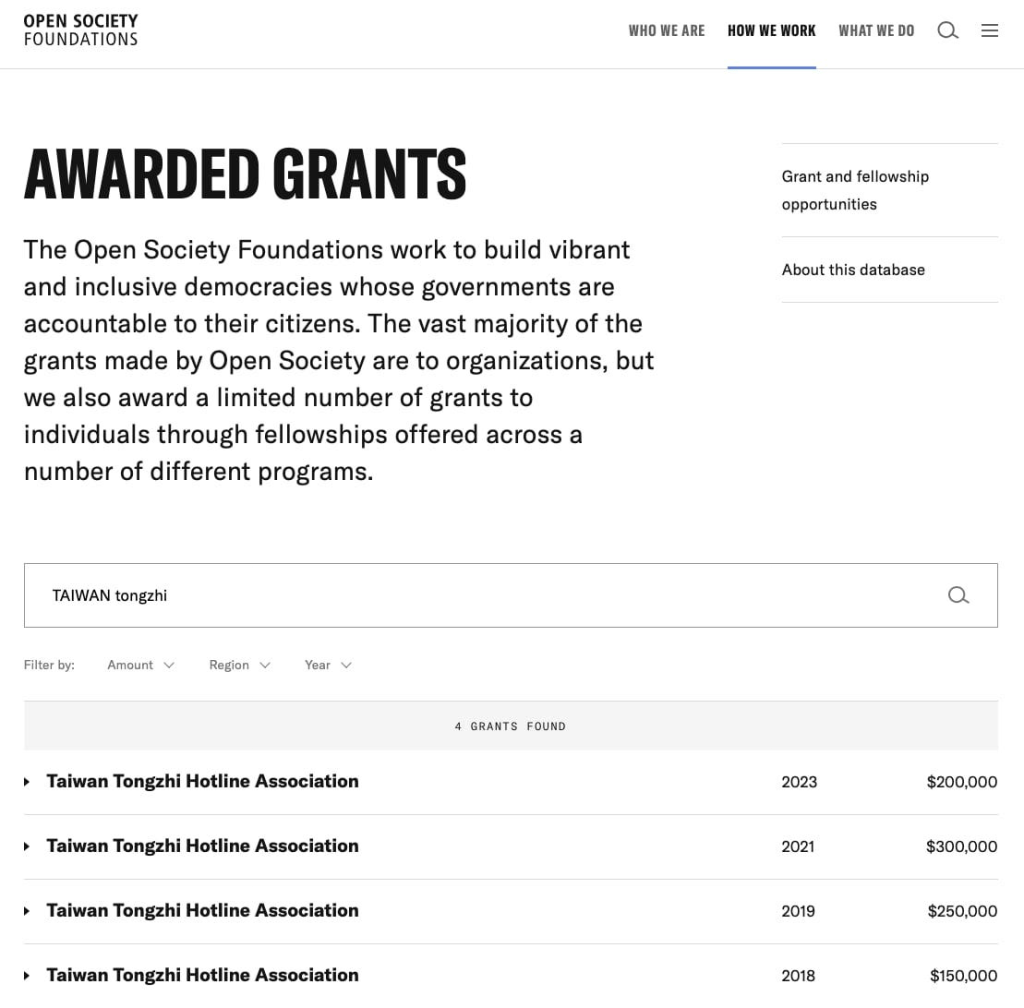
- NGO Influence and Foreign Funding – Organizations such as the Taiwan Tongzhi Hotline Association and the Sunshine Queer Center have played a pivotal role in shaping public policy. These groups and others receive international (re: Western) funding, mirroring the activist-led push seen in Western nations before their recent reversals on gender medicine. Open Society Foundations (OFS) has donated close to $1 million USD to the Tongzhi Hotline.
A foreign billionaire-backed foundation is directly shaping Taiwan’s social and political landscape by funding groups that lobby for policy changes. Soros, a self-proclaimed globalist who believes in breaking down national, cultural, and traditional barriers, funds movements that dismantle traditional structures—whether they be national sovereignty, religion, family values, or biological sex distinctions, and replaces them with state-enforced identity constructs.
Another of the sponsors of these Taiwan based groups is an American NGO, spawned by self-identified male lesbian “Susan” Stryker, a man notorious for, among other things, fighting to close a women’s single-sex service rape crisis center in Canada because it refused to accommodate males. These groups have been known to use funding as a way to pressure governments into adopting policies that align with their agendas, and become less accountable to local communities and more beholden to foreign donors. This isn’t just about LGBTQ+ rights—it’s about who controls Taiwan’s social policies. OSF and similar foundations are not neutral actors; they are ideologically driven organizations using financial power to reshape societies globally.
Taiwan is simply the latest recipient of this NGO industrial complex’s agenda.
- Public Narrative Control – Taiwanese media, heavily influenced by NGOs and foreign-funded activist organizations, has framed opposition to child sterilization and medical experimentation as “anti-LGBT” rather than a medical ethics issue. This discourages critical debate and silences dissenting voices, including those of detransitioners and medical professionals.
The Global Backlash Against Gender Medicine
The international shift away from so-called “gender-affirming care” is clear. In the UK, the Cass Review, an independent report led by Dr. Hilary Cass, exposed the lack of evidence supporting the medicalization of gender-distressed youth. The review found that puberty blockers and cross-sex hormones pose serious risks, including decreased bone density, infertility, and lifelong dependence on medical interventions. As a result, the UK’s National Health Service (NHS) has shut down the controversial Tavistock gender clinic and significantly tightened regulations around pediatric gender medicine.
Similarly, Sweden—once seen as a pioneer in gender medicine—has reversed course. The Swedish National Board of Health and Welfare now only permits puberty blockers and hormones in extreme cases, citing lack of scientific backing and concerns about long-term harm. Finland, Norway, and several U.S. states have followed suit, recognizing that minors lack the cognitive maturity to consent to life-altering medical decisions.
Even WPATH (World Professional Association for Transgender Health)—the primary global body setting standards for transgender medical care—has faced internal controversy, with whistleblowers and former members warning that its guidelines prioritize ideology over scientific rigor. They expose the reality that these practices are neither sound science nor ethical medicine. For instance, they discuss blocking puberty in a 10-year-old and a 13-year-old child with developmental delays. Another exchange describes performing genital surgeries on individuals diagnosed with schizophrenia and dissociative identity disorder (previously known as multiple personality disorder). These files are difficult to read, but I urge you to examine them. Like most, I have no objection to adults making choices about their own bodies. However, we should all be deeply concerned about unregulated medical experiments performed on individuals who, due to their age or cognitive ability, cannot give informed consent.
Taiwan’s Path Toward Medical Harm
Despite mounting evidence against child medical transition, Taiwan’s Ministry of Health and Welfare recently released its “LGBT+ Care Guidelines”, which outline conditions for minors to access sex reassignment surgery. While the guidelines prohibit genital surgery for children under 12, they allow puberty blockers and other medical interventions at even younger ages. Minors between 12 and 18 can undergo medical transition with approval from a “professional team”—a vague and subjective criterion that raises serious ethical concerns.
Taiwan’s decision stands in stark contrast to global trends. Rather than taking a cautious, evidence-based approach, the government appears to be yielding to activist pressure, promoting treatments that have been widely discredited in other nations. Doctors in Taiwan are already performing gender surgeries on minors, with some dismissing the role of age altogether.
Dr. Hu Zhengxuan of the Gender Reassignment Center at Linkou Chang Gung Memorial Hospital openly stated, “It is unreasonable and illogical to use age to directly distinguish whether a person can undergo surgery.”
This sentiment echoes the talking points of trans activist groups worldwide, many of which have financial ties to medical institutions that benefit from lifelong hormone treatments and repeated surgeries. This raises the question: Is Taiwan’s medical community prioritizing ideological compliance over patient safety?
The economic burden of transitioning further exacerbates the issue. Families with the financial means can afford to medically transition their children. A recent interview with a father of a “transgender” sixth-grader revealed that his family spends 15,000NTD (roughly $450USD) every three months on puberty blockers—while the average monthly salary in Taiwan is around $45,000NTD which translates to roughly $1,500 USD per month. Some teens have been documented as going to the Taiwanese blackmarket for hormones in order to avoid parental consent or visits with doctors, with a young woman retelling her account of purchasing testosterone and seemingly bragging about going through early menopause as a result of prolonged use.
At the same time, activist groups in Taiwan are working to normalize these treatments. Organizations such as Taiwan Tongzhi Hotline Association are providing support groups for parents of children who claim to be transgender, similar to previous efforts aimed at normalizing gay and lesbian sexualities. However, there is a stark difference between supporting children’s identities, and medicalizing them with unproven and irreversible interventions.
This Western agenda has been seen in across Taiwan, where trans-identified males teach students that they are “half male and half female”, an American school is accused of providing students with sexually explicit material that actively promotes gender ideology, a trans-identified male politician openly threatens women without censure, the disappearance of women’s single sex restrooms into “all-gender restrooms” (while the men’s rooms remain intact), and allowing trans-identified males to compete in women’s sports.
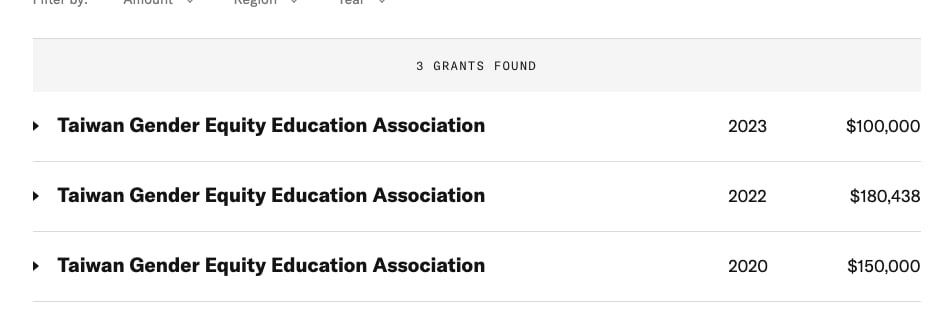
OSF provides over $430,000USD for supporting “gender inclusive education” in Taiwan.
Ignoring Regret and Detransitioners
Taiwan’s reckless policies fail to address the growing number of detransitioners—young adults who now regret their medical transitions. While activist groups argue that regret is rare, recent studies suggest otherwise. Research from Sweden and the UK indicates that many individuals who undergo childhood medical transition later experience serious mental health issues, social difficulties, and physical complications. Long-term use of cross-sex hormones can lead to infertility, osteoporosis, cardiovascular issues, and metabolic disorders. Those who had mastectomies (top surgery), hysterectomies, orchiectomies, or genital reconstruction may suffer from chronic pain, nerve damage, loss of sexual function, and complications such as infections or fistulas. Many procedures are irreversible, and attempts to restore lost function (e.g., breast reconstruction or stopping hormone therapy) come with medical risks.
Even prominent trans-identified activists have admitted that some individuals deeply regret transitioning but are too afraid to speak out due to the aggressive and often violent nature of transgender advocacy groups.
Taiwan’s Dangerous Isolation
Like multiple studies have shown, around 85% of children with gender dysphoria desist by the time they are adults. Most children grow out of their gender dysphoria as they reach adolescence. Social transitions and/or puberty blockers are frequently used to ameliorate symptoms in these children, however, the long-term psychological impact of these strategies on children is unknown. By ignoring global medical trends, Taiwan is setting itself up for a future scandal akin to the Tavistock controversy in the UK. The question is not if Taiwan will face a reckoning on gender medicine, but when. Will the government continue to push unscientific and harmful policies, or will it heed the warnings from nations that have already learned the hard way?
Taiwan is rapidly reaching “peak woke” as it embraces a range of Western ideologies, particularly in gender politics without critical examination. Universities, media, and government institutions are increasingly aligned with these ideological trends, silencing dissent and enforcing compliance through political correctness and institutional pressure. As Taiwan positions itself as a leader in “progressive” policies in Asia, it risks sacrificing women’s rights, free speech, and cultural values in favor of an imported, ideologically driven framework that has already proven divisive and destabilizing in the West.
As the world wakes up to the dangers of gender ideology, Taiwan is walking blindfolded into a medical ethics disaster. The time to reverse course is now—before more children become the next victims of an irreversible experiment.
 Jaclynn Joyce