My recent interview discussing my work, my studies, and most importantly…cheese!
I know great people…and they consider me pretty great, too! Great enough, so it seems, to be featured on the podcast I Know Great People.
I Know Great People is a series of conversations intended bridge the gap between our knowledge of what people do, and the perception, or misperceptions, people may have about these occupations or lifestyles. What’s it really like being an expat in Taiwan? A university lecturer in Asia? Pursing a PhD? In my (lengthy, sorry!) interview we focus on my studies and my work in Taiwan. Topics include what led me to go to Taiwan (and to stay!), challenges that I overcame (or still struggle with), unexpected benefits and drawbacks, and the most important question of all…what kind of cheese do I like best??
I had a blast recording this. I hope you enjoy listening!
(Originally published on Canada’s largest feminist news site, Feminist Current)
Image: Focus Taiwan
On October 30th, I am presenting on the topic of “Gender and Immateriality” at the 29th Annual Conference of the English and American Literature Association in Taiwan and, funny enough, Taiwan is currently awash with news of sex self-identification. Gender identity ideology has ripped through Western society at full force, bringing out tired old stereotypes and misogyny disguised as progressive thinking, and is now extending across the globe.
On September 23, the Taipei High Administrative Court issued a ruling allowing a trans-identified male calling himself “Xiao E (小E)” to change his legal sex to female without sex reassignment surgery — the first of its kind. Until now, individuals could not change their sex on an ID card unless they provided medical certificates confirming a diagnoses of gender dysphoria and proof of a sex change operation.
How did this ideology reach Taiwan — an Asian nation on the edge of the Pacific? It appears certain groups in Taiwan have been working in near secrecy to make this happen.
The last three decades has seen Taiwan join the ranks of the most vibrant democracies in Asia. Since democratization began in the 1990s, democracy and respect for human rights have become an increasingly prominent part of the island’s identity and values. Taiwan became the first country in Asia to legalize same-sex marriage in May 2019. I was there at the marches, rallies, and the Pride Parades leading up to this monumental victory for equality. What marriage equality, the women’s rights movement, and the civil rights movement have in common is that they extended the rights of a privileged group to everyone. When well-meaning people in Taiwan hear “trans rights,” they assume something similar is being demanded. But that isn’t the case. What campaigners mean by “trans rights” is the “right” to identify as the opposite sex — socially, legally, and in every other context.
But, this isn’t a human right.
Equal access to housing, healthcare, employment, and safety are basic rights that (should) belong to every person in the world. Ensuring all individuals can live free from harassment, violence, and discrimination is also a worthy goal, and trans-identified people deserve this, like everyone. But it is not a human right to demand to be treated either socially or legally as female, if you are male. Women fought to have access to single-sex spaces, services, and opportunities — allowing males to access female-only spaces like change rooms, shelters, and prisons should not be framed as a human right. It is not a human right to endanger vulnerable women and girls. It is not a human right to require that everyone accept subjective beliefs as objective reality. It is a privilege to demand to be socially and legally treated as the opposite sex — to compel the speech and the actions of others. Demanding everyone subscribe to your faith-based beliefs (or at least say they do) is comparable to state-sanctioned religion.
The acceptance of and legislating around gender identity ideology is happening at a very rapid pace in the country I call home. The following is a timeline of Taiwan’s progression to self-ID*:
1988 : Two doctors defined the surgical requirements to change one’s legal sex in Taiwan as the removal of reproductive organs and the completion of so-called “sex reassignment surgery” (SRS), including vaginoplasty and phalloplasty.
Other criteria for legally changing sex in Taiwan included:
Living as opposite sex for at least two years and adapting well
Having the support of parents and family
Being aged between 20 and 40 years old
Patient intelligence above mid-range, an IQ score of between 85 and 115
Ruling-out patients seeking to perform surgery due to mental disorders, paraphilic disorders, or excessive mental stress
For 20 years, this remained the only way to legally change your sex in Taiwan.
November 2008 : As SRS is often expensive and quite risky, human rights organizations and various activists worked with the Department of Health (now called the Ministry of Health and Welfare), to change the 1988 criteria to the following:
“Application of trans-identified individuals requires two certificates of diagnosis from two different licensed Taiwanese psychiatrists, and a certificate of diagnosis from a licensed Taiwanese medical institution stating the removal of breasts, uterus, and ovaries in women, and penis and testes in men.”
The difference being that now, no vaginoplasty or phalloplasty was required after the surgery.
October 2013: The Office of the President Human Rights Committee held a meeting and decided the Executive Yuan should coordinate with the Ministry of Interior and the Ministry of Health to come up with a better policy for legal sex changes.
December 2013 : The Ministry of Health held a conference on sex change registration requirements. The conference agreed on the following conclusion:
“The legal change of gender registration should not require ANY medical requirements or prerequisites.”
The conclusion also stated that details should be discussed further with affected agencies and ministries. No women’s organizations were mentioned or consulted.
January 2017 : The Taiwanese Society of Psychiatry published the following statement on their website:
“It is not recommended to allow the change of legal gender solely based on Psychiatrists’ Certificates of diagnosis. We recommend that the government should form a special agency dedicated to this specific purpose instead, to ensure and protect the rights of the affected individual.”
September 2021 : Taiwan court rules to allow a male identifying himself as “Xiao E (小E)” to change his legal sex to “female” without surgery.
The Chinese language news outlets that covered this case (UDN News, ET Daily, Apply Daily, LTN Liberty Times) all did so with no comment on how these changes would impact women in Taiwan. Across the board, they printed copy and paste statements from groups representing trans activist interests, and offered no counter opinion or discussion of potential harm to women and girls. The two English language news outlets to discuss the case — Focus Taiwan and Taipei Times — provided the barest of details and also failed to discuss negative impacts on women.
According to a Taiwanese source I spoke with who is active in the LGBTQ community, in 2020, the Executive Yuan (Taiwan’s highest administrative branch) funded research on public opinion regarding gender self-ID, which is being led by the gender studies department at a local Taiwanese university. The project is called “Legalization of Gender Change Requirements and Legislative Suggestions,” and aims to assess public and/or LGBTQ community opinions on self-ID requirements to provide the Executive Yuan direction on possible legislative change. The research is being compiled via a series of questions conducted online using a Google form.
According to an anonymous source I spoke with who works for the government, the research is strongly biased towards requiring only self-declaration of identity. This research is costing the Taiwan government upwards of 1.3 million Taiwan Dollars (roughly $37,000 USD). The survey seems, almost by design, very difficult to find online — a government official who reached out to me had trouble finding the Google form, and, unlike the general public, he actually knew what to search for. Searching online for information on the research being conducted — or the survey itself — only reveals the institutions who bid to conduct the research. The only actual links to the form are found on transgender or LGBTQ related forums. The organizations behind the research do not seem interested in including the general public and are heavily biased, only seeking out participation from a few select groups within the LGBTQ community.
There are many trans people around the world who acknowledge that surgery cannot actually change one’s sex. Not all of those who have had sex-change operations and/or identify as “transsexual” or “trans” push to enter female spaces, or force others to use incorrectly sexed pronouns. Trans is not a monolith, and many with dysphoria are under no illusions about their biological reality. Yet, trans-identified individuals who deviate from the preferred narrative are not being included in the conversation. It appears as though the Executive Branch already knows what they want to include in their bill, which, if passed, will ensure one need only self-declare an inner sense of “gender identity” in order to legally change sex. They are promoting what is called a “legal fiction,” which is created when the law acts as if something is the case, for certain defined legal purposes, when in fact it is not. Humans cannot change sex, but we are being coerced into an immersive fiction by Taiwan’s government into believing they can.
This graph shows the increase in trans-identified men and women over the years in Taiwan. Note the disproportionate increase in trans-identified males. This graph was published by the National Yangming Jiaotong University using information provided by Taipei Veteran General Hospital. (According to the Taiwanese calendar, which counts years starting from the creation of the Republic of China, the numbers 85–102 refer to the years 1996–2013.)
Even the term, “gender identity,” is a misnomer — in fact, gender identity legislation requires others to identify you as a member of the sex you proclaim.
But one cannot “identify” into sex. All of us are born one of two biological sexes, easily observable at birth 99.98 percent of the time. [Exceedingly rare disorders of sexual development (DSDs) are medically identifiable conditions that deviate from the sexual binary norm. They do not constitute a third sex.] Gender, on the other hand, is a subjective and socially constructed concept, not an objective biological entity. The words male and female cannot refer to an immutable biological fact and a social construct or subjective identity, simultaneously. And setting aside the sticky issue of what it would even mean to “feel” male or female, why would such a feeling matter if physically being male or female does not? Why should immaterial feelings of “femaleness” matter in law, trumping the material reality of our physical bodies?
Convincing people to accept identities that are subjective and have no basis in material reality is not an easy task, which is probably why this recent ruling was a surprise to many in Taiwan. If you want everyone to accept your gender identity as valid, then the populace must be persuaded that sexed bodies are not material, but that gender identities are. If you think you cannot convince your populace, you try to push through laws without their knowledge or informed consent.
Material facts about the way women are treated in society — and the protections and spaces we require — must be acknowledged in consideration of this issue. Allowing men to self-identify as women and access women’s spaces and resources causes harm to the original members of the category “woman.”
Studies show that most males who identify as transgender retain their genitalia. Changing the law in order to allow these males access to women’s spaces means any man at all can access women’s spaces, essentially making all spaces mixed-sex spaces, to the detriment of females.
Feelings of being born in the “wrong body” are unverifiable, no matter how strongly felt and expressed. They do not constitute scientific evidence of objective material reality. “I think I am a woman, therefore I am a woman” cannot be the basis for the legal definition of a woman. It legally disenfranchises women to remove biological sex from the definition of womanhood, or to have it superseded by gender identity.
I have always loved people who rejected gender stereotypes: David Bowie, Boy George, Marlene Dietrich, Annie Lennox, Grace Jones, and every member of BTS — women who dared to be what we deem masculine and men who choose not to be. The idea that women should be “feminine” (soft, submissive, subservient) and the idea that men must play sports and guzzle beer, or that they shouldn’t wear makeup or show their emotions, are gender stereotypes. I support rejecting gender. Given that I support gender non-conformity and breaking apart stereotypes, you might think I would be happy about today’s gender ideology. But I am not. That is because rather than reject gender stereotypes, gender identity ideology says we must define ourselves by them. It is a step back, and it has been skillfully sold as progressive.
It is disappointing to see a thriving democracy like Taiwan circumvent discussion on this topic and use sleight of hand to pass a law that will negatively impact its citizens. It is reminiscent of its recent authoritarian past, under the guise of being “inclusive.” It is disappointing to see that women’s organizations, trans people who don’t advocate gender identity ideology, and the general public have been left out of the conversation. The government should be able to provide legal protections for trans people, without eroding the legal status, rights, and existence of women. Language matters, because that is how we describe reality. When we erase the meaning of the word woman, we erase women, the oppression women face, and the rights women have fought for.
The backlash is already being felt. On popular Asian social media platform Plurk, people are talking about what the government is trying to do, angering many. Young, liberal, educated people want to protect the rights of trans people, but do not want to accept self-ID and intact males in female spaces. Taiwanese women around the city have begun a campaign using messaging app, Line (possibly the most popular way to communicate in this country), detailing the case, and urging their friends, family, and members of the community to contact their local legislators to complain about this verdict. They are wondering why they have been strategically left out of the conversation.
October 2021: Anonymous members of the LGBTQ+ community in Taiwan began distributing leaflets explaining the ruling and its implications via social media and messaging apps like Line. Concerned citizens also created an online petition to appeal the ruling on self-ID, on account of wanting to protect women only spaces. Currently, only Taiwanese citizens or permanent residents of Taiwan can sign the petition.
A pamphlet distributed on social media in Taiwan explains the harms of gender identity legislation.
January 2022 : The research currently being conducted will be summarized into a report and the Executive Yuan will then write a bill based on the results. The time to act is now. Contact your local legislator and make your voice heard.
*Note that in Mandarin Chinese, there is no distinction made between the words sex and gender. In Taiwan, when terms like “gender registration” and “legal gender” are used, they are referring to biological sex.
Prior to 1988 there was no regulation or law regarding changing ones sex in Taiwan
Jaclynn Joseph is a Hawai’i born — now Taiwan based — PhD student and university lecturer.
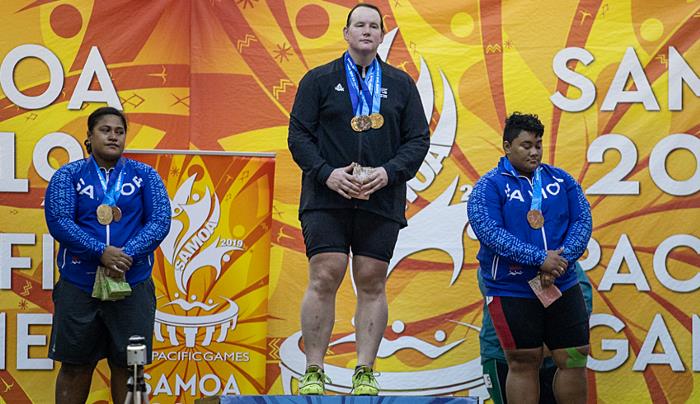
Image from Fiji Sun – Hubbard wins the gold at the Pacific Games in Samoa in 2019. His inclusion meant a WOC lost a medal. Representatives of the nation of Samoa have been speaking out against Hubbard’s participation in the women’s category since 2019.
Since winning a gold medal in the 2019 Pacific Games in the female weight lifting division, Hubbard, who is from Auckland, has had my attention and that of the world. Why? Because as a male a good two decades older than his female competitors, his participation in the Olympics as a trans-identified male athlete in a female sport requires us all to suspend reality…and to lie. Something I am not comfortable with and something you shouldn’t be comfortable with either.
I have been continually shocked by the (very loud and increasingly foaming at the mouth) support Hubbard receives online. People continue to refer to him as if he were a woman (not a transwoman, a literal woman). However, using this language is to agree to and propagate the fallacy that individuals are actually able to change their biological sex, which is impossible. Imagine actually believing it when someone says, “It’s okay if a man competes as a woman, “her” testosterone levels are below the acceptable threshold. Now her body is exactly that of a biological woman’s!” Is how one feels about oneself more important than the physical reality of their body? To believe in gender identity, you would have to think that one can perceive one’s own sex separate from the material reality of one’s body. When did we come to accept the idea of “gendered thoughts” or “gendered feelings” as valid and should be affirmed through the legal process? It is a statutorily undefined concept at best. (1)
Even with lower levels of testosterone, if you hit puberty as a male, then your bones will be denser than the average woman (peak male bone mass is around 50% more than women’s), your lungs and heart will be more prominent, and muscles will be capable of handling higher levels of pressure. Body size will increase, hands, shoulders, and feet grow much larger than an average woman’s. Men have, on average, 66% more upper body muscle than women, and on average, women are around 30–35% muscle by weight, while men are 40–50% muscle. Men have much lower body fat percentages. Men have higher hemoglobin levels. I could go on, and on, and on. (2) How testosterone affects the strength and muscle mass is just the tip of the iceberg. Women are not the weaker sex in all areas (women have better vision, higher levels of pain tolerance), but our bodies are fundamentally different. And of course, men can’t give birth because, well…they’re male. Having testosterone/estrogen treatments doesn’t change the physiological effects on the male body during puberty causes. There is no scientific evidence to suggest that this advantage is negated through cross-sex hormone use.
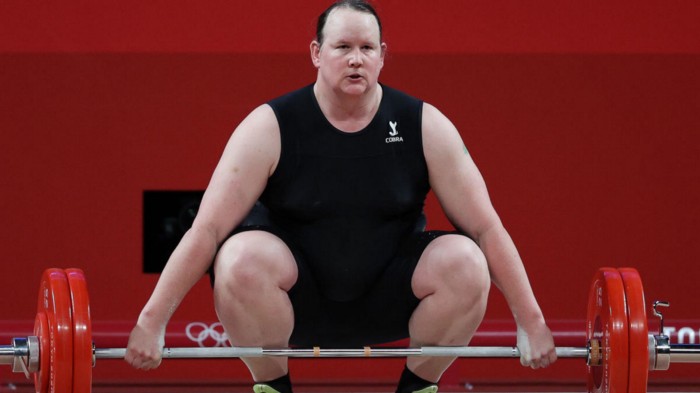
Now come all the “arguments” that a (middle-aged, morbidly obese) trans-identified male has no advantage over female athletes… although he managed to qualify for the Olympics while recovering from an injury and being two decades older than the average female competitor in his field. In fact, the year that Hubbard “debuted” in female weightlifting, he set a new world record in the heavyweight category.
Of course, another incoherent argument is “transwomen are women,” the same as all other women. Any suggestion to the contrary is meted out with the overused accusation of “transphobia.” There is quite literally no bigger bully than the ones advancing this anti-female agenda. Part of me was hoping that Hubbard would win to galvanize people into action. I still hope this helped peak people, upset people, motivate people to push back again this regressive ideological cult. He won’t be the last male stealing awards and spaces from women, and in fact, several other trans-identified men are competing in women’s sport in the Olympics this year!
To sum this story up, a male, with all the biological advantages that confers and cannot be negated (male puberty), competed against and took places that otherwise would have gone to marginalized women of color. Gender, however one wishes to define it, is not the same as sex. Women require spaces of their own, and Laurel Hubbard’s participation in female sport is a clear example of male privilege and sexism. To argue for men’s inclusion into women’s sport is not only fundamentally heterosexist; it also serves an old claim that women need to take care of men and put their needs before their own.
Hubbard competing in the 2021 Olympics. Women can’t afford to be nice about this threat to our sports and our spaces. (Image from CBS Sports)
References:
Barrett, Ruth. ‘Female erasure: what you need to know about gender politics’ war on women, the female sex and human rights.’ Pacific Palisades, CA: Tidal Time Publishing, LLC, 2016.
I’m not ashamed to admit it. I’ve always had a particular interest in ancient history, traveling around the world to visit sites, monuments and museums in parts of the once classical world that have peaked my interest over the years. In my younger days I stumbled across mention of the great social experiment known a Sparta, but hadn’t given it the attention it deserved until the 2007 film 300 (based on the 1998 comic series of the same name by Frank Miller and Lynn Varley), which absolutely blew me away. I developed quite an interest in Spartan (or as I prefer to call them, and the name they actually used for themselves, Lacedaemonian) history, with emphasis on Spartan women. (How the heck could I not, after seeing Lena Headey play Queen Gorga?!) Unfortunately, I quickly discovered that there was a whole lot of misinformation out there about Spartan women. Sure, their lives were unarguably better than it was for women in other Greek city-states, or polis (plural: poleis). But was Sparta the feminist utopia that films like 300 (and it’s sequel, Rise of an Empire) made it out to be, with fiercely independent queens and women warriors?
I tried to break it down into simple categories below, with both good and bad, using other classically contemporary Greek city-states as comparison and counterpoint. I use the word Greek loosely, as there was no united “Greek” identity, but in doing so I mean one of the city-states, poleis, of what we now refer to as ancient Greece. The ancient Greeks were very aware that they were by no means culturally identical, but they almost all agreed that they had more in common with each other than not — with one exception: the Spartans.
Early Life and Education- Sparta:
A bronze statue of a Spartan woman exercising (either running or dancing, historians aren’t sure) c. 500 BCE. (Go see it at the British Museum) One derogatory slur used again Spartan women was to call them “thigh flashers”, and you can see why from the statue above.
Girls in Sparta received a separate state-sponsored education to boys, but they did indeed receive some sort of public educational program. Girls were mainly taught at home by mothers and domestic Helots (slaves), while boys attended the agōgē (the rigorous education and training program mandated for all male Spartan citizens, with the exception of the firstborn son in the ruling houses) from ages 7–29. Most historians agree that Spartan girls could read and write. They were actively encouraged to perform physical activities like gymnastics, running, wrestling and dancing, and their education focused heavily on the physical dimension. They raced (both on foot and on horses) and exercised in public, not sequestered away. Adolescent girls went through a process of public education and socializing which imbued them with society’s ideals and helped shape their adult behavior. They also received the same share of food as their brothers, keeping them healthy and fit and their lifespans longer than found in other Greek poleis. It’s pretty clear that the Spartan’s did not see women as categorically inferior to men, like their neighbors did.
But…
This sounds great, but keep in mind that this education in physical fitness had to do with the Spartan mentality that the fitter the woman, the stronger the son she could produce. It was a form of Spartan eugenics and an attempt to create stronger offspring, ideally male. Women were not allowed to train with weapons, and although women completed in their own, women-only, sporting events, no women were allowed to participate in the sporting events of the Olympics. One very interesting loophole to the Olympics rule involved a Spartan princess named Cynisca (her name, oddly enough, meant something like “Girl Puppy”). She competed in the Olympiads in the four-horse chariot races — as an owner and breeder of horses, not as a driver — and won in 396BCE and 392BCE, becoming the first woman to win in the games. Technically she didn’t compete, her driver did, but she was an expert equestrian and a talented horsewoman.
My ancestors and brothers were kings of Sparta.
I, Cynisca, victorious with a chariot of swift-footed horses,
erected this statue. I declare that I am the only woman
in all of Greece to have won this crown.
Inscribed circular stone base of a four-horse chariot dedicated by Cynisca of Sparta, winner of the Olympic chariot races.
Early Life Education- The rest of Greece:
What education?
The position of women in ancient Greece differed between time, city and class, but women were generally not given any sort of formal education. Most Greeks believed women were naturally and categorically inferior to men, physically deformed or malformed, intellectually lacking and on same the level as children. Why send them to school? Aristotle sums up the Greek view of women with this quote:
“The female is, as it were, a mutilated male, for there is only one thing they have not in them, the principle of soul.”
Girls learned how to cook and prepare food, run a home and do housework, make clothing and raise children, and that’s generally where their education ended. A few notably Greek women could read and write (Sappho) but only wealthy families who had servants or slaves to take care of the domestic activities could afford to teach their daughters to read and write. Spartan women, conversely, never (or very rarely) were required to do these things, depending instead on the work of Helots, a subjugated slave population who performed the labor that was the bedrock on which Spartan leisure and wealth rested.
Rights and Law- Sparta:
Spartan women had more rights and enjoyed greater autonomy than women in any other Greek polis of the Classical Period (which would be the 5th-4th centuries BCE). Women could inherit property, own land, make business transactions, and as have seen, were better educated than women in Greece in general. Literary sources written by male Athenian authors make it sound as though it was considered shameful for an (upper class) Athenian woman of the citizen class to even go outside the home unless it was for a religious occasion, and she certainly wouldn’t have been allowed to speak to other men, let alone do gymnastics!
But…
Like women in other Greek poleis Spartan women were legally prohibited from taking part in any of the official processes of the Spartan government. They could not take part in meetings of the apella(the assembly of all male Spartan citizens over the age of thirty) and they were forbidden from holding any form of public office. Spartan women almost certainly exerted some political influence, but any influence they had was behind the scenes.
Rights and Law- The rest of Greece:
Women outside of Sparta in the ancient Greek world had few rights in comparison to male citizens. Unable to vote, own land, or inherit, a woman’s place was in the home and her purpose in life was the rearing of children.
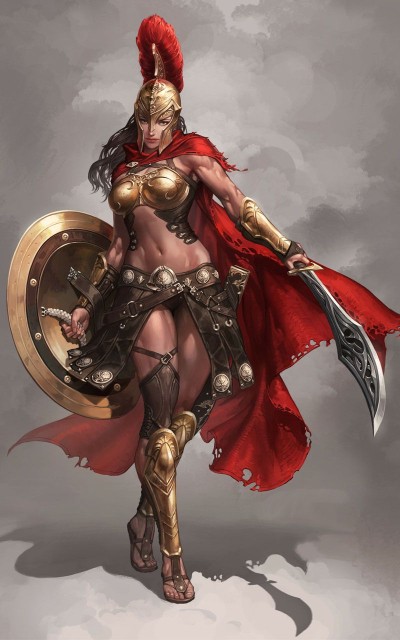
What prepubescent male mind did this leak out of? Spartan women have developed an almost Amazonian mythology, but unfortunately for us (and men living in their parents’ basement) nothing about this image is accurate. (Image at Pinterest)
Marriage- Sparta:
Spartan women generally tended to marry at a more mature age than Greek women in most cities. Women tended to marry in their late teens, men married in their mid-20s, and most women married men not much older than themselves. This was for the purpose of procreation, to ensure that the Spartan female was physically and mentally fit for sexual intercourse and bearing healthy children. Husbands and wives lived separately until the husband turned 30 years old. Before that, he lived in barracks with other warriors, and she managed her household and finances, only seeing him if he could sneak away at night to work at producing male heirs.
But…
Debunking the movie 300, I’m sure a lot of people, myself included, thought that Spartan society must really have been feminist and fiercely female, but the fact is that Spartan women were valued exclusively for their ability to produce strong sons who would eventually be able to fight in battle on behalf of Sparta. Every Spartan girl was expected to become a wife and a mother. The ideal Spartan women needed to pump out as many sons as possible, and like most women of the time they had little say in their choice of husband.
One interesting fact I learned was that only unmarried Spartan women kept their tresses long. Upon marriage, Spartan women shaved their heads and then continued throughout their lives to keep their hair close cropped. They also possibly wore a veil. The image of Lena Headey as Queen Gorgo, with her beautiful, wavy locks of long hair, are unfortunately completely inaccurate.
Marriage- The rest of Greece:
Girls were married off by the time they hit puberty, so 12 or 13 wouldn’t be an odd age for a bride. Husbands were usually much older, chosen or approved of by the father. In Athens, in the case of a father dying without male children, his daughter and heiress had no choice but to marry her nearest male relative (an uncle or first cousin) in order to receive her inheritance…which then passed directly on to her Uncle-Husband. Yuck.
Conclusion
300 may not have been the most accurate film, butthere’s no doubt in my mind that Spartan women were the most remarkable group of women in all of Greece. Female Spartan citizens enjoyed status, power, and respect that was unequaled in the rest of the classical world. The higher status of females in Spartan society started at birth. Unlike in most other Greek city-states, Spartan girls were fed the same food as their brothers. Nor were they confined to their father’s house or prevented from exercising or being out in public. Spartan women competed in sports and were skilled dancers and athletes. Rather than being married at the age of 12 or 13, Spartans discouraged the marriage of a girl until she was in her late teens or early 20s. The reasons for delaying marriage were to ensure the birth of healthy children, but the effect worked to spare Spartan women the hazards and lasting health damage associated with pregnancy among adolescents. It wasn’t perfect, but Sparta was by far the best of the city-states in ancient Greece to be woman.
The author in the polis of the enemy! Athens was the principal enemy of Sparta during the Peloponnesian War. Fortunately for us, despite the centuries, the earthquakes, the wars and unrest, we can still marvel at sites like the Acropolis. (Image is the property of the author.)
References: (More can be found underlined and linked throughout the article)
My main reference was the brilliant book The Spartans: The World of the Warrior-Heroes of Ancient Greece by Paul Anthony Cartledge
Not too long ago, I was caught up in the whirlwind of applying to Ph.D. programs, waiting what felt like an eternity for decisions and experiencing the anxiety of choosing between programs that best fit my interests. Hours turned into days of deliberation, soliciting advice, and finally making a decision.
Finally, I was accepted to a Top 20 university, my first choice not only because of its impressive ranking but because it was one of the few Women’s Studies programs left in the world.
I encountered a few difficulties during my first semester — some of them familiar to most Ph.D. students and some I could never have anticipated. By the end of my second semester, it was clear that the program wasn’t the right fit for me. I won’t delve too deeply into any specific experiences, but some things weren’t lining up.
First, I disagreed with the way the university policed our language and what we wrote about. Second, my cohort and some of the faculty seemed angry, self-righteous, and lacking in intellectual humility. Third, I felt betrayed that I had applied to a Women’s Studies program that was changed to Gender Studies one year later.
The rise of women’s studies programs in the 1970s and the “women-centered” approach most university women’s studies programs and classes promoted is quickly disappearing, if not entirely gone already. The shift of women (objective) to male-centric “gender” (subjective) studies meant that I was now spending tens of thousands of dollars a year to be in a program based around hyperbolic ideology, not fact-based analysis. I arrived at the party after the last call.
Switching programs isn’t easy, but it’s better than dropping out. Unfortunately, between 30 percent and 50 percent of doctoral students drop out, with the highest attrition rates in the first two years.
Research suggests that is primarily due to systemic issues at institutions, despite the engaging narrative that there must be some deficiency in departing students. Many programs suck, but applying all over again to different schools can be daunting.
I finished two years of my schedule before I dared to say No More. And it took me a whole year to apply, get my documents notarized (the joys of being an ex-pat), sent off, approved, sent somewhere else, sent somewhere else again before I was finally accepted into a shiny new program on a shiny new continent.
I didn’t apply to another Women’s Studies program. Still, I did manage to find a similar enough program that allowed me to continue my doctoral research and saved me thousands of dollars each year in tuition. Talk about a win-win!
I’m not going to sugar-coat it. Unlike changing your major as an undergrad, changing graduate programs can be a challenge, and it’s really not encouraged.
Even under ideal circumstances, you may be required to forfeit hard-earned academic credits and some of the rapport you have built with faculty members and other students. But remember, if you dropped out, this would most likely happen anyway. The key here is to perform a thorough cost-benefit analysis, reflecting honestly on why you started the doctoral process in the first place, what you need to be successful, and what your goals are.
That said, why spend four or more years of your life pursuing a degree that you’re not passionate about?
The whole point of graduate education is learning more about the one subject that excites and inspires you. So if you’re not in a program that does that for you, and you’ve realized that another degree path does, then you should consider switching programs.
I’m literally only doing a Ph.D. because I have a passion for learning. I am child-free by choice and have the finances and drive to dedicate to a doctorate — this is my version of having a child! An expensive, annoying child who causes me vast amounts of pain and sleepless nights for 5 or 6 years.
Finally, you need to take into serious consideration your mental health.
Mental health is essential for success in doctoral study, but it doesn’t get the attention it deserves because of the powerful stigmas surrounding it in academia. For example, at my first institution, specific experiences put significant strain on me mentally and emotionally. I was barely balancing everything going on in my life, and the stress took a physical toll on me.
In the end, changing programs ended up being the best choice for me.
Medical malpractice has been committed on a global scale because few are willing to challenge an ideological lie.
(Keira Bell — Photo from: The Economist)
You may not have heard of this courageous young woman, but she is raising awareness worldwide of the dangers of gender ideology. Thanks the judicial review brought by Bell, the age for prescription of puberty blockers for children has been raised.
Why is this a big deal?
Bell is one of a growing number of detransitioners who are realizing all too late that what they experienced in Tavistock’s GIDS (Gender Identity Development Service) and Portman NHS Foundation Trust (UK), was a form of manipulative child abuse and homosexual erasure.
Bell was given puberty blockers at age 16, after just three, one hour long appointments with “specialists” at GIDS. She had a double mastectomy a few years later. Now 23 years old, Bell is still suffering from effects of the testosterone (facial hair, deepen voice, having gone through artificial menopause as a side effect of the puberty blockers), and has to live with the fact that she is most likely infertile because of the drugs given to her when she was merely a teen. Because puberty blockers are still experimental (and yet handed out to children like candy), Bell has no idea whether or not she will suffer from other, even more serious side effects in her later life.
‘When I was questioning my identity there was nowhere to find support that didn’t affirm the delusion of being in the “wrong body”. No organisations existed that might be able to tell me that it was okay to be a girl who didn’t like stereotypically “girly” things, and that I was no less female because I am same-sex attracted.” — Keira Bell [1]
Suffering from anxiety and depression as a teenager, a growing unease in her female body thanks to the awfulness that can accompany female puberty, and an acute awareness of her same-sex attraction, Bell sought help, comfort and guidance. Unfortunately, she was very much let down. Instead of questioning, with respect and compassion, the underlying problems Bell was clearly suffering from, such as depression, self-hatred and low self-esteem, the clinic for children advised this teenage girl that she was indeed male, and that the best treatment for her dysphoria was to immediately begin blockers which would stop her puberty development.
“I had a one-hour appointment and it was very general, surface-level stuff. ‘What is your preferred name? Do you want to transition?’ And a lot of stereotype talk about whether I played with boys’ toys, preferred boys’ clothes. There was no discussion about my sexuality.” — Keira Bell [1]
I have compassion for those with gender dysphoria, and I understand the need for some people to medically transition. I have seen how it can help and I support adults, who are fully aware of the consequences of their decisions, who decide to go through with this process. However, all this does is alter the external appearance of the body so that someone’s visible phenotype is more like the sex they want to be. This is particularly harmful to young gay men and lesbians discovering their sexuality in a world still fraught with homophobia. When a girl says that she “feels like a boy” or literally “is a boy”, that sentiment may reflect her perception of how her personality and preferences compare to the rest of her peers. Instead of agreeing and saying she is now male, because she doesn’t like stereotypically feminine things, why aren’t we encouraging her to expand on the notion of what it means to be female? Why are we limiting her? As a lifelong supporter and advocate for the homosexual community, this blatant attempt at homosexual erasure is shocking. Lesbians have faced the same old combination of misogyny and homophobia from the right and are now being relentlessly scrutinized by the liberal left and the clinics claiming to “help”. Most feminists would say that the female gender role exists purely as a sexist stereotype of woman rooted in essentialism and misogyny. GIDS and their minions claim that womanhood is simply the performance of the female gender role. Keira, you don’t like pink, babies, high heels or makeup? You’re clearly male! Because that’s all we are now, ladies. Stereotypes. To anyone who possesses even the tiniest amount of commonsense, this is all dangerous, ideologically driven, and completely irrational nonsense. Bell, at 16, effectively received assistance, after three brief meetings, to sterilize herself.
It’s not particularly surprising that no organizations challenged Bell’s idea that she was a boy born in the wrong body. Anyone who challenges gender ideology risks cancellation, harassing, threats and abuse. Fears of being labeled “transphobic” have led to the institutionalized and systematic subordination of the best long-term interests of gay and lesbian youth. In academia, critical inquiry has been suppressed as far as scrutinizing how “gender identity,” as a concept, conflicts with sex and sexual orientation. People like myself, lifelong advocates for the gay and lesbian community, get attacked and vilified for speaking out against gender ideology.
Statistically, the majority of children grow out of ‘gender dysphoria,’ if allowed to grow up, without interference — About 75% would grow up to be lesbian, gay, or bisexual, and about 85% would grow up to be lesbian, gay, bisexual, or straight. [2]
Why are we forcing people into boxes? We, as adults, should be expanding our understanding of what normal male and female behavior and preferences look like. Nobody fits perfectly into expected gender roles and stereotypes. We should understand that being male and being female both come with a wide range of personalities, preferences, and possibilities. You’re a human being. You have a personality that is uniquely you, not some regressive gender label. Sex is real and whatever sex you are, you’re stuck with it, but your personality gives you the limitless freedom these stupid gender identity labels don’t. How have we come so backwards that members of our society now openly assume that male children must be “masculine” to be male and female children must be “feminine” to be female. This is homophobia positing that masculinity signifies some innate “maleness” and femininity signifies some innate “femaleness.” Boyhood can include activities and clothing associated with girls, just as girlhood can include activities and clothing associated with boys. Preferences for objects associated with the opposite sex do not make somebody the opposite sex. Nor does one’s sense of self regarding one’s own body, or even one’s sexual orientation in relation to the body of someone else, make one into some other sex than one is.
“What is being called “gender identity” is likely an individual’s perception of how their own sex-related and environmentally influenced personality compares to same and opposite sexed people. Put another way, it’s a self-assessment of one’s stereotypical degree of “masculinity” or “femininity,” and it’s wrongly being conflated with biological sex. This conflation stems from a cultural failure to understand the broad distribution of personalities and preferences within sexes and the overlap between sexes.” William J. Malone, M.D. [3]
Keira Bell is courageous, but it remains questionable whether her story will have a happy ending. Literally scarred, physically altered in ways she can never reverse, potentially dealing with future illness and discomfort, she is only the first of many victims to come forward. I expect to see many, many more lawsuits from men and women in the coming years.
-A very informative and nuanced book on Rapid-Onset Gender Dysphoria (ROGD) as a social contagion amongst teen girls.:
Irreversible Damage: The Transgender Craze Seducing Our Daughters by Abigail Shrier. I highly recommend it!
Additional resources for young people affected by these issues:
[2] Ristori, J., & Steensma, T. D. (2016). Gender dysphoria in childhood. International Review of Psychiatry,28(1), 13–20. doi:10.3109/09540261.2015.1115754
For people who claim to be against colonialism or appropriation of others’ cultures and lived experience, it seems like pretty much all they ever do. It’s amazing such a house of cards built on contradictions ever gained any traction.
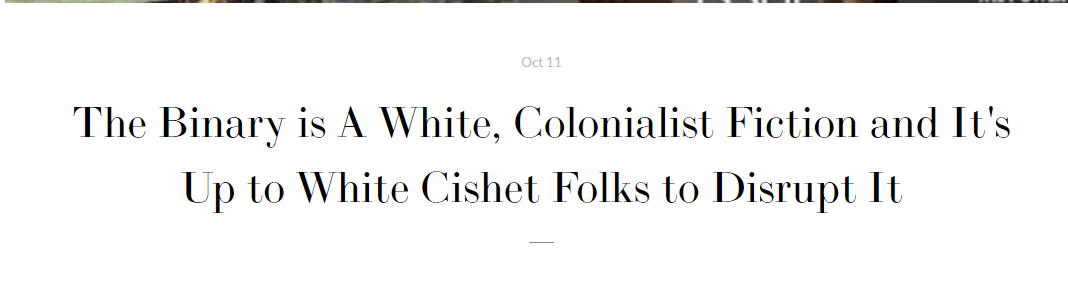
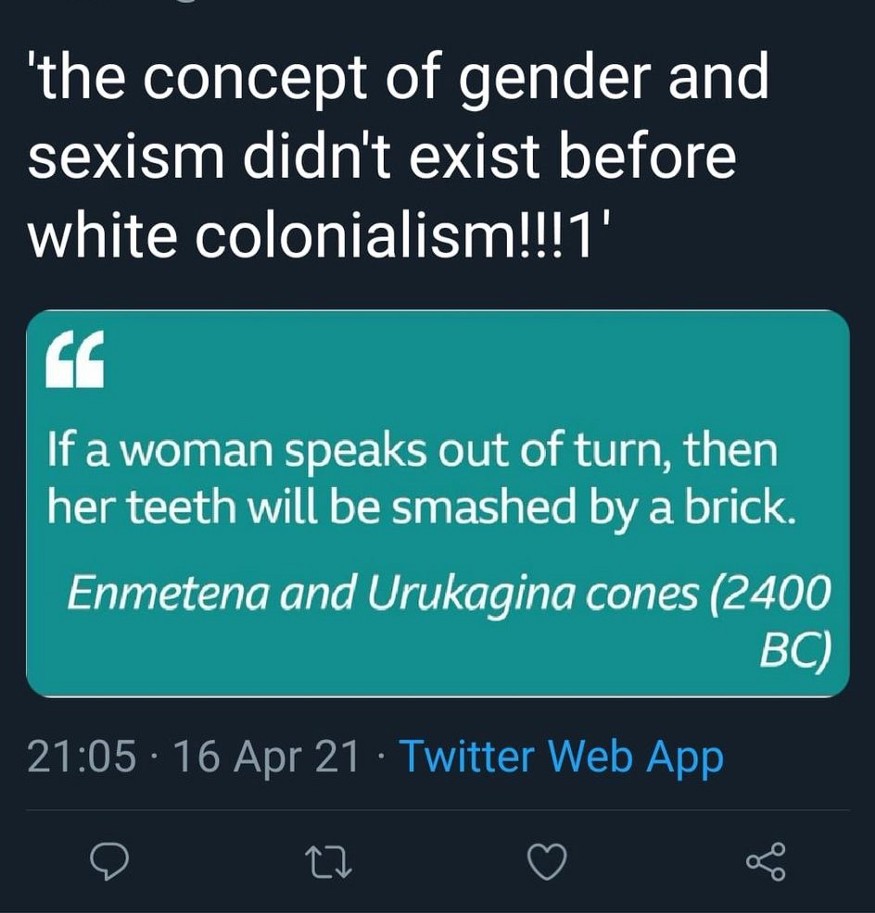
Have you seen headlines like these? At first I thought that they were satire, or at the very worst a small minority of outspoken yet naïve writers who merely sought to garner attention with a controversial headlines. Unfortunately, statements like these have become common amongst certain activists attempting to promote the idea that the sex binary was a colonialist construct imposed by the force of white supremacy and European imperialism. They muddy the water further by intentionally conflating sex and gender. The modern gender binary as we know it (encompassing the sex role stereotypes of masculinity and femininity), in places like North America or in Europe, are culturally specific and restricted to a relatively recent period of time, but there are certainly analogous social concepts in many, if not most, historical, pre-colonial cultures around the world. There are in fact a variety of social conceptions of gender in historical and modern cultures that would be deemed “non-binary”, “third gender” or simply “other”, but it is crucial to note that binary systems of SEX existed historically in every community throughout history, all around the world.
All cultures are complex, nuanced, and possess good and bad elements. Pre-British contact, Indian widows (only widows, not widowers) practiced sati or suttee,in which a widow killed herself by sitting atop her deceased husband’s funeral pyre. In Aztec society, women had limited leadership roles within the empire and were not allowed to be warriors. Foot binding was the Chinese custom of breaking and tightly binding the feet of young girls in order to change the shape and size of their feet, popular because it was believed to tighten the women’s thigh and pelvic muscles and heighten the sexual pleasure of the men who possessed them. The idea that societies who hadn’t contacted Europeans were utopias of progressive behavior, where women were unbound by patriarchy, their reproductive capacity not controlled entirely by men, where female sexuality wasn’t strictly policed, is ludicrous. People around the world knew how babies were born prior to the white man coming to let them know. To imply otherwise is to embrace an ahistorical eurocentrism.
The central flaw in the argument that whiteness brought forth the sex binary is that encourages the idea that a practice is good and worth defending by virtue of simply being non-white and non-Western. This notion is preposterous, not to mention foundationally racist, and pure Noble Savagery. The Noble Savage isan archetype, an idealized concept of humanity which symbolizes the innate goodness of one not exposed to the corrupting influences of Western (colonial) civilization.(1) The original Noble Savage myth was a tool which enabled racists to promote the centrality of race while simultaneously advocating violently racist modes of ordering society. There is now a new Noble Savage myth 2.0 concerning the immateriality of gender, and it is no less dangerous and no less a tool of the uninformed.
The concept of the Noble Savage was first invented by the philosopher Jean Jacques Rousseau in the mid-eighteenth century in order to glorify the “natural” life of original man.
While I agree that in many cases the gender binary, masculinity and femininity as we have it imposed upon us in the Western world, was forced upon other cultures via European colonization, the sex binary was not. In fact, extra gender identities, like gender in general, rely heavily (if not entirely) on the sex binary to exist in the first place. And far from being progressive, “third genders” are patriarchal nonsense and simply a way for people (historically, almost entirely all male bodied people), to find a place in society when they did not conform to that particular society’s vision of what manhood should be. The prevalence of “two-spirit” or “third gender” identities, far from being a measure of progress, actually correlated with the rigidity of gender roles within a society(2). If you study history, you’ll find that more egalitarian societies with less gender socialization had an absence of ‘two-spirit’ people due to their lack of emphasis on sex-assigned gender roles(3).
There is a phrase on the Enmetena and Urukagina cones (Mesopotamia)— the earliest known law codes from circa 2400 BCE — that says, “If a woman speaks out of turn, then her teeth will be smashed by a brick.”
Samoan culture is often lauded as progressive for its cultural acceptance of fa’afine, the social category of effeminate males. ‘“Fa’afine are identified at an early age by virtue of their propensity for feminine tasks”(4), and so the concept is wholly dependent upon the sex role stereotypes. There’s only one acceptable way to “be a man” in Samoa, and if you don’t fall in line, you’re “othered”. Historically, fa’afine do not deny their sexed bodies as men. In fact, there are several professional athletes who are fa’afine, and they play on men’s teams. We can find similar examples of this within the Native American Lakota tribe. Winktewere generally homosexual or effeminate men who couldn’t find a place within their society where sex roles were strictly enforced, and thus were given a “third gender” identity(3). Why were no Lakota women “two-spirit”, while the men were? There is little to zero historical evidence that women in any society were allowed to upgrade their positions and “become men” or “live as men”. I have not found a single example of a society in which the notion of any sort of third sex is not influenced by patriarchy and proscribed/prescribed gender roles. The vast majority of these third sex categories apply to effeminate or gay males but not to masculine or lesbian women. Whilst third gender categories have historically been created to accommodate gay men, no such categories have been created which would allow lesbians to exist outside of heterosexual society. In Hawai’i, where I am originally from, we have māhū. MāhūinNative Hawaiian and Tahitian cultures are “third gender” people (similar to Samoan fa’afafine), who were, historically, all male at birth.
American Samoan fa’afafine footballer Jaiyah Saelua (far right) is a member of the American Samoa national football team (a men’s team).
Let’s look at things another way. Let’s take into account that it’s men in power throughout history who impose gender roles, and that these patriarchal societies had to have somewhere to put “men who don’t ‘act like’ men” because of masculine male gender policing and social control(3). In cultures where aggressive, macho masculinity is prized above all in men and boys, these identities serve to absorb all the men who don’t “fit”, especially effeminate gay men. Why do we continue to promote this? Misrepresenting and romanticizing these identities results in a social climate where important nuances are lost or buried. Every variation of socially-constructed gender throughout history (including masculinity and femininity) has existed to enforce the nuclear reproductive family and to ‘other’ those who do not conform to or partake in it; particularly homosexuals. Societies around the world, throughout history, have consistently created separate social categories and stereotypes for men, women and homosexuals. And this isn’t a good thing.
In the modern world, this is playing out in countries like Iran where homosexuality is a crime, punishable with death for men and lashings for women(5). In Iran, both lesbians and gay men are often coerced into undergoing the radical procedures such as sex reassignment surgery, so as to “cure” them of their homosexuality, which is outlawed in the Islamic Republic. Everyone must adhere to rigid gender roles and stereotypes, the fixed beliefs and assumptions of how men and women “should” behave, or they’ll be punished.
Does all this mean that men and women cannot or should not break the hold that gender has over us? Of course not. There have been fabulously different, creative, and expressive people flying across gender lines for centuries. But, that does not make biologically born men and women capable of changing their sex…which was something we once knew but seem to have forgotten along the way.
Ironically, there is nothing more Western than modern gender ideology, starting from the blatant appropriation or outright theft of “third gender” concepts from other cultures. Gender roles are a prison, and the significance of biological sex cannot be disregarded, in spite of recent efforts to reframe gender as an identity rather than a hierarchy. Depoliticizing gender, adopting an uncritical approach to the power imbalances it creates while trying to rewrite history, benefits nobody…least of all women. Only the abolition of gender will provide liberation from the restrictions it imposes. The shackles of gender cannot be re-purposed in the pursuit of freedom. In the end, gender ideology is the ultimate colonizer.
Works cited:
(1) Fairchild, Hoxie Neale. The Noble Savage: A Study in Romantic Naturalism (New York). 1928.
(2) Jeffreys, S. Gender Hurts. (NY: Routledge). 2014.
(3) Bell,Deirdre. Toward an End to Appropriation of Indigenous “Two Spirit” People in Trans Politics: the Relationship Between Third Gender Roles and Patriarchy. CulturallyBoundGender. 2014.
(4) Schuerkens, Ulrike. Global Forces and Local Life-World Social Transformations. Sage Publications. 2004.
As a student of women’s history, I find myself at times overwhelmed by the androcentric history (of nearly everything but particularly) of philosophy. For example, Descartes’ mind-body distinction, while not explicitly androcentric, is nonetheless understood to be androcentric when put in the context of Western culture where man is continually identified with mind (reason) and woman with body (irrationality). But studying philosophers of the past, like Rousseau, can be surprisingly relevant to present problems if we simply turn them on their collective heads; reading Rousseau is a useful exercise in knowing the enemy. Despite what we already know about these men, it is good to read phallocratic texts like theirs as an exercise in exposing the ideology that still aids in oppressing women today. Philosophy (and history) are open to influence, they bear the marks of their makers, they show signs of the soil from which they have sprung. Philosophy is made in a social world, and a world that excludes women might leave signs of that exclusion in philosophy, and make philosophy an agent of that exclusion.
I’ve briefly highlighted some of the men I’ve been reading, and my frustrations with their work, below. Enjoy my rant!
This only applies to XY chromosomes. XX need not apply!
Oh the irony of Jean Jacques Rousseau, made particularly ironic (and illogical) when one considers that he preached radical egalitarianism. ‘Man is born free, and everywhere he is in chains’…thunders the inspiring first line of the Social Contract. And if one never read any of his other works one might remain under the blissfully ignorant illusion that when he used the word ‘man’ he meant ‘mankind’.
‘I would a thousand times rather have a homely girl, simply brought up, than a learned lady & a wit who would make a literary circle of my house & install herself as its president. A female wit is a scourge to her husband, her children, her friends, her servants, to everybody. From the lofty heights of her genius, she scorns every womanly duty, and she is always trying to make a man of herself….’ [1]
Did he deliberately foster this illusion of egalitarianism? I think so. And the women of revolutionary France (women like Olympe de Gouges, Charlotte Corday, Madame Roland and Théroigne de Méricourt), who played such a significant role in the French Revolution, were thoroughly conned. In his History of the French Revolution, the historian Jules Michelet wrote, “Men stormed the Bastille, women caught the king” [2], thus emphasizing women as a driving force in prompting revolutionary developments. Yet women’s positions in France became even worse after the Revolution with regard to political rights. The revolutionaries demonstrated a willingness to bar women from politics and restrict the political body to men alone. Perhaps, if the women of France had been able to compare The Social Contract with Rousseau’s other work, Emile, the course of history might have been very different. “To renounce one’s liberty is to renounce one’s quality as a man, the rights and also the duties of humanity”….man is born free, but women must be kept in chains.
The French Revolution of 1789 brought with it hope for a new social order characterized by liberty and equality for all. These concepts of liberty and equality stemmed from Enlightenment ideas that spread throughout France in the decades preceding the Revolution. While the Revolution’s propagation of these ideas opened the path towards universal male liberation, they limited the social and political freedoms of women by confining them to the private sphere. During the Old Regime, women had no formal access to politics, but they were not alone, since most men were in the same exact position. However, after the Revolution women were explicitly and legally denied from any participation in government. While women largely accepted their subordination and confinement to the private sphere, revolutionary principles motivated them to fight for better treatment against government policies that invaded their domestic lives. Although at times helpful to the Revolutionary cause, women’s involvement in the public sphere generated male anxiety due to fear of social ruin caused by female ignorance and insubordination. In an attempt to restrain women from interfering in their affairs, the men of the Revolution passed laws that deprived women of any social or political existence.
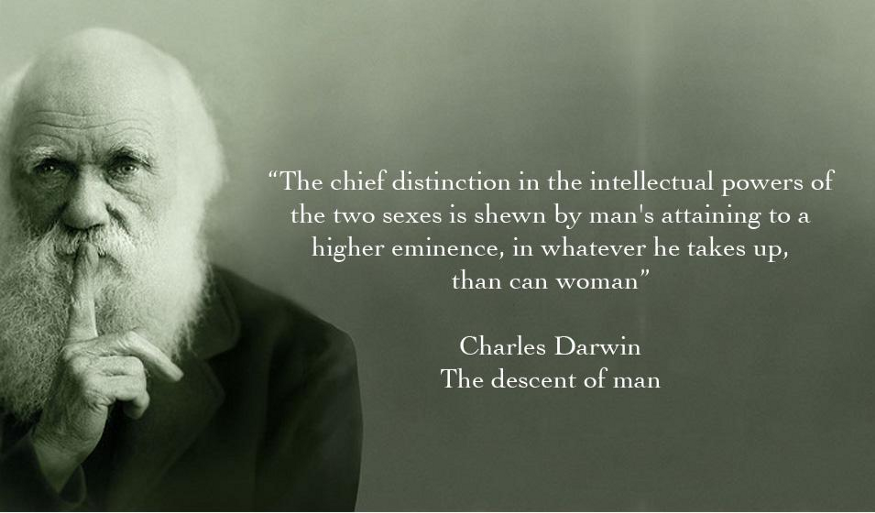
Nearly identical to the view held by Rousseau were those of Charles Darwin, who stated:
‘Woman seems to differ from man in mental disposition, her greater tenderness and less selfishness…some of these faculties are characteristic of the lower races, and therefore of a past and lower state of civilization. The chief distinction in the intellectual powers of the two sexes is shewn by man attaining to a higher eminence, in whatever he takes up, than woman can attain — whether requiring deep thought, reason, or imagination, or merely the use of the senses and hands. Thus man has ultimately become superior to woman. It is, indeed, fortunate that the law of the equal transmission of characters to both sexes has commonly prevailed throughout the whole class of mammals; otherwise it is probable that man would have become as superior in mental endowment to woman, as the peacock is in ornamental plumage to the peahen.’ [3]
Similar to Rousseau, Darwin makes women at once inferior and morally better, equates her good qualities with those thought at the time to represent more primitive qualities, and apologizes for man’s civilized behavior with a self-satisfied smirk. Darwin’s fundamental difficulties on the topic of man and woman seems to stem from his inability to make a clear distinction between social conditioning and inherited tendencies.
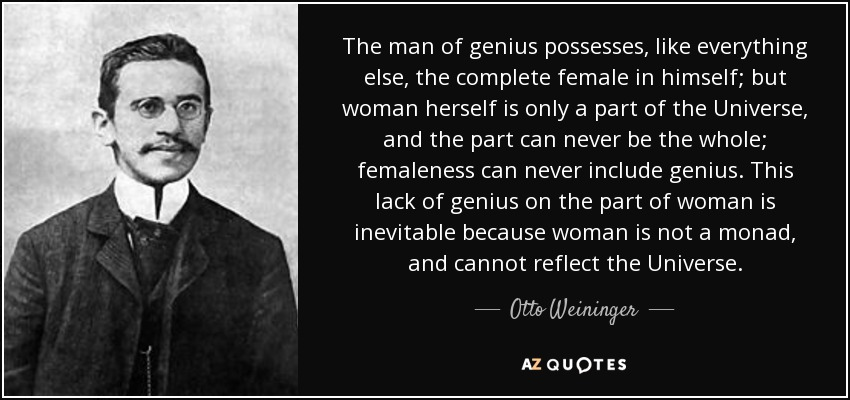
In the history of nineteenth-century German philosophy there is a distinct relationship between anti-Semitism and anti-feminism, in the sense of hostility towards women and an emphasis on her general inferiority. It’s an interesting lesson that should teach us about the dangers of attempting to categorize people on the basis on physical features or their physique, whether it is a matter of sex or skin color. Philosopher Otto Weininger wrote at great length on the supposed foulness of women (and the “femininity of the Jews”). The female, Weininger stated categorically, cannot be possessed of genius. Why? Because she is little more than an animal. Genius is a glorified masculine innate imperative.
Weininger didn’t get validation for his work and killed himself at age 23. But remember, only men can be rational geniuses!
‘As the absolute female has no trace of individuality and will, no sense of worth or love, she can have no part in the higher, transcendental life. The intelligible, hyper-empirical existence of the male transcends matter, space, and time. Women have no existence and no essence; they are nothing. The meaning of woman is to be meaningless.’’ [4]
From the soulless woman Weininger moves on to what he refers to as the soulless Jew, who is denigrated for being too ‘womanish’ and as such is also incapable of genius. (Weininger, by the way, was born Jewish).
This unstable, insecure man, whose male genius had not been sufficiently recognized by the time he was 23 years old, killed himself. Ironic for a man who identified masculinity and manhood with reason and rationality!
Arthur Schopenhauer is at first an attractive idealist philosopher, but of course he was a bitter misogynist and found women…”in every respect backward, lacking in reason and true morality…a kind of middle step between the child and the man, who is the true human being.”[5] Authors Rodgers and Thompson in Philosophers Behaving Badly call Schopenhauer “a misogynist without rival in … Western philosophy”.[6] Schopenhauer might be read as more extreme than most of the other men mentioned in that he sees literally no other purpose to women than continuing the human race (as breeding stock), and no value to their lives as distinct from their value to the species.
Schopenhauer and all men believing in his accounts of women are very much at fault of everything they claim women to be. For a philosopher to claim so confidently how he understands what woman are, as a fact, is a big sign of having veered of the philosophical path. Schopenhauer clearly had biased views due to his own bad experiences with women, notably his turbulent relationship with his mother. Fortunately, it seems that during his elderly years Schopenhauer finally became aware of the potential that women have (as long as they set themselves apart from the common behavior of others).
Before I get to reading about continental philosophy (Julia Kristeva, save me!), one final note…the idea that racist, sexist or otherwise bigoted views automatically disqualify a historical figure from study is misguided. Anyone who cannot bring themselves to study such a historical figure betrays a profound lack of understanding about just how socially conditioned all our minds are, even the greatest. Because the prejudice seems so self-evidently wrong, they just cannot imagine how anyone could fail to see this without being depraved. But accepting this does not mean glossing over the prejudices of the past. The good news it that the past twenty-five years have seen an explosion of feminist writing on the philosophical canon, a development that has clear parallels in other disciplines like literature and art history. Feminist philosophers are engaged in a project of re-reading and re-forming the philosophical canon, in order to include women in the philosophical “us”
Works cited:
[1] Rousseau, Jean-Jacques. The Emile of Jean Jacques Rousseau: Selections. New York: Teachers college, Columbia University, 1956.
[2]Michelet, Jules. History of the French Revolution Publisher: Chicago : University of Chicago Press, 1967.
[3] Darwin, Charles. On The Origin of Species by Means of Natural Selection, or Preservation of Favoured Races in the Struggle for Life. London :John Murray, 1859.
[4]Clack, Beverley. The Philosophy of Religion:A Critical Introduction. Polity, 2019.
[5] Schopenhauer, Arthur, and T B. Saunders. Essays of Arthur Schopenhauer. New York: Willey Book Company, 1910.
[6] Thompson, Mel. Rodgers, Nigel. Philosophers Behaving Badly. London : Peter Owen Ltd, 2005
Other works referenced:
Figes, Eva. Patriarchal Attitudes (London, 1970)
Proctor, Candice E. Women, Equality, and the French Revolution. Connecticut: Greenwood Press, 1990
This is being used on social media to promote incorrect statements about sex and gender in Taipei, Taiwan
I have seen this poster floating around groups in Taipei. I do not doubt that the people presenting it are well-meaning, well-intentioned people who want to build a more equal and just world. I have to ask myself, have they taken the time to critically examine the assumptions underpinning these beliefs they propagate in service of a particular ideology? The poster contradicts what I teach my students, and what I will be teaching my students in the future as a professor. They are teaching and encouraging the use of terms that seem to be purposely manipulative, illogical and irrational by design. What is the end goal? Are they well-meaning but caught up in the current popularity of Social Justice? Some are virtue signaling, still others fear being ostracized and left out and repeat mantras they’ve been told make them “good people”. I broke down the most problematic aspects of the poster in sections below.
– It’s difficult to find value in plurality, to accept multiple perspectives at one time when they are mutually contradictory. This incoherence, not attempting to make rational sense of anything, almost seems by design. (I’m looking at you, Judith Butler!) What do I mean? Well, they claim that gender is a social construct but simultaneously avow that a person can be ‘trapped’ in the wrong gender. They define a spectrum inclusive of both binary and non-binary people, despite the term non-binary defying any binary categorization. Despite arguing that there are no true differences between men and women, they then use regressive sex role stereotypes to argue in favor of a ‘gender identity’. Most hypocritically, they claim to promote self-expression, individualistic conceptions of truth and self-identity but impose upon us a rigid acceptance of their own ideology, which is a feelings-based fabricated construct, irrespective of its conflicts with others’ identities and beliefs. (For instance, they try to tell me I am “cisgender” or even HAVE a gender…) Queer Theory produces and maintains rigid categories and scripts people into them…it’s (nearly entirely) unreasonably and radically socially constructivist. It’s like a religion, not stating what IS, but rather what OUGHT to be thought and believed. Feminists have been critiquing the hierarchy of gender for years, and with good reason. The logic of gender identity is fundamentally flawed, resting on the premise that gender is innately held. As feminists have argued, gender is socially constructed. This Applied Postmodernist approach is the antithesis of Feminist Theory.
-There seems to be an abundant confusion, or at the very least conflation, regarding sex (biological) and gender (metaphysical). Gender meaning the deceptively simple, quasi-mystical idea that everyone is born with a “gender identity” — an innate sense of being a man or woman that usually, but not always, aligns with biological sex. This feels to me like manipulation of language attempting to stray away from the scientific grounding that biological sex has. ‘Gender identity’; a term that encompasses a spectrum of atypical and non-conforming gender types but seemingly has no strict requirements other than how one feels or identifies. In fact, such a belief is paradoxical — the existence of gender itself is, by definition, inherently oppressive to, primarily, women. The aspects of a gendered identity which one person deems to be positive will equally act to oppress another, who would be unrepresented by such a definition (for example, if someone thinks to be feminine is to make babies…). Not only is this concept of gender regressive and harmful, but the noxious idea that we can associate a positive set of behavioral characteristics with a physical sex is intrinsically flawed and anti-feminist. Love it or hate it, like all mammals, humans come in two sexes. Sex is observed at birth, NOT assigned. (The existence of intersex conditions in no way changes this fact. It is a highly misleading umbrella term for rare developmental disorders of the genitals and gonads, some of which are so minor their “sufferers” do not even know about them, and hardly any of which raise any doubt as to whether an individual is male or female or where they place on any sort of putative “sex spectrum.”)
-Being cis means “identify[ing] with the gender you were assigned at birth.” Here again they are conflating gender and sex, incorrectly stating one is assigned a sex at birth when sex is observed, and gender is a set of trivial characteristics associated with the performance of masculine or feminine behaviors…certainly not something an infant is capable of. Having the limitations imposed by gender used to define the trajectory of their development is the earliest manifestation of sexism in a child’s life, which is particularly damaging for girls. The essentialism behind assuming women identify with the means of our oppression rests on a belief that women are inherently suited to that oppression, that men are inherently suited to wield power over us. In other words, categorizing women as ‘cis’ is misogyny. To frame inhabiting a female body as a privilege requires a total disregard for the sociopolitical context of society. The label “cis” is imposed on us, without our consent — a word that forces us back into the 19th century, when women were said to be inherently “feminine” and therefore unfit for public life.
We are talking about ideology, here: the notion that one can change sex, or that one can be born in the wrong body is a belief, rooted in nothing but faith. And here we are, in modern, progressive Taiwan, teaching people that science is not real, that reality can be imagined away through feelings or words, and that to question this faith is “bullying.” In fact, those whom this ideology claims to serve are in the long run disenfranchised by this ideology. Allowing for the reification of gender is not by any means a liberating or inclusive ideology. Those who feel feminine or masculine, who desire to perform gender, are best served by a society that understands that gender is a social construction and that sex is a biological construction, and that those levels are categorically distinct. Rather than calling anyone who is critical of gender ‘TERFs’, they should work together with them to construct a world that accommodates both the objective world (sex) and the subjective world (gender), and allows for the most free and inclusive expression of humanity.
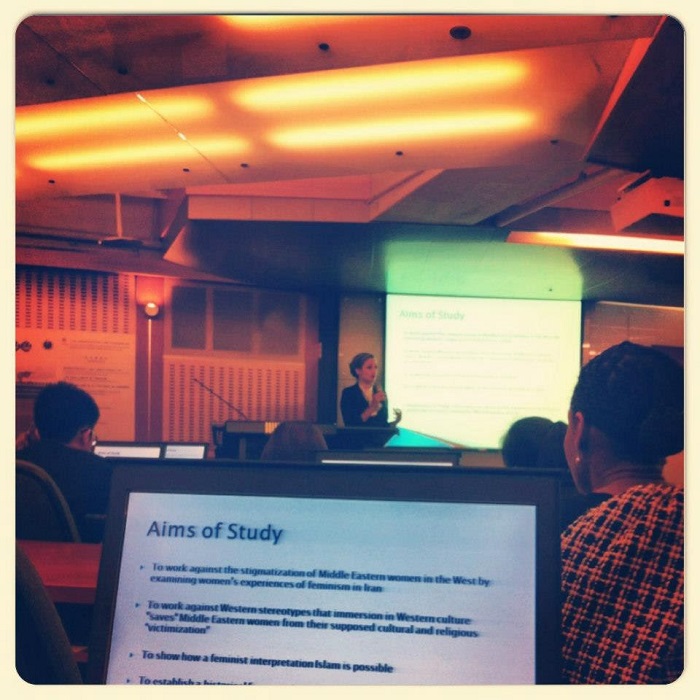
(The author speaking at a university in Taiwan on the topic of Feminist Politics in the Middle East)
“If all mankind minus one, were of one opinion, and only one person were of the contrary opinion, mankind would be no more justified in silencing that one person, than he, if he had the power, would be justified in silencing mankind.”
― John Stuart Mill, On Liberty
In John Stuart Mill’s view, other people, no matter how numerous or powerful, simply have no right to prevent you from thinking freely or expressing your thoughts. Mill went further, saying that silencing speech was not only an offense against those who are prevented from speaking, but also against those prevented from hearing them. Across societies and across history, few cultures have valued free speech much, which is exactly what makes the freedom found on US campuses, this unprecedented liberty of expression, so unique. For many Americans, speech is primary, it is the first freedom, without which the others could not exist. A society where expressing unpopular ideas means you will be fired from your job, exposed and derided in the media, and shunned by the community is not the kind of free speech society Mill described in the quote above, which begs the question: what do we value more in our society: individual autonomy or enforced altruism? How can we come to know our world, our reality, if we do not allow individuals the responsibility to gain an understanding of how the world works and act on the basis of that knowledge? Exercising that responsibility requires social freedoms, and one of the social freedoms that we need is speech.
We have the capacity within ourselves to think, or not to. But that capacity can be hampered severely by a repressive social atmosphere of collective group-think, orthodoxy and a paralyzing fear of challenging the collective. We get all sorts of values from one another. If we are going to share and learn from each other and if we as educators are going to be able to teach others, then we need to be able to engage in certain kinds of social processes, like asking ridiculous questions, debate, criticism, lecturing, etc. But all of this presupposes an important social principle: that we will tolerate those things in our social interactions. Part of the price that we pay is that our feelings and our opinions will be bruised on a regular basis, but we live with these metaphorical bruises.
“To suppress free speech is a double wrong. It violates the rights of the hearer as well as those of the speaker. It is just as criminal to rob a man of his right to speak and hear as it would be to rob him of his money.” ― Frederick Douglass
Of all the ideas percolating on (predominantly North American) college campuses these days, the most dangerous one might be that speech can equate to violence. We’re not talking about verbal threats of violence (which are used to coerce and intimidate) or libel, both of which are illegal and not protected by the First Amendment. We’re talking about speech that is deemed by members of an identity group to be critical of the group, or speech that is otherwise upsetting to members of the group. Postmodernists try to put forth the argument that speech is action, as it propagates through the air and impinges upon the person’s ear who hears it. Technically, they are correct. Speech is physical. But there is a big quantitative difference between sound waves breaking over your body and a baseball bat breaking your bones. Both are physical, but the results of being hit by a bat involve consequences over which you have no control; the pain in not a matter of your interpretation. By contrast, how you interpret or respond to the sound waves breaking over you are entirely under your control. Whether you allow them to hurt your feelings depends on how you evaluate the interaction you are engaging in. There is a distinction between speech and action. I can say something that may hurt your feelings, but I can’t run up to you and hit you with a baseball bat. The government can, and should, come after me in the latter case but not in the former.
Speech is not violence. Treating it as such is an entirely interpretive choice and it is a choice that increases pain and suffering while preventing other, more effective responses. The idea that teaching and learning and education all best take place in an environment of free expression means that places of higher learning, colleges and universities, should be morefree than the surrounding society, not less so. University students and faulty should be able to speak their minds more freely than people can in other professional environments. In fact, it should be a prerequisite for being on campus. Viewpoint diversity is necessary for the development of critical thinking, while viewpoint homogeneity (whether coming from the political left or right) leaves a community vulnerable to group-think and orthodoxy. It benefits us to be exposed to different ideas. Otherwise we become unable to defend and ultimately unable to understand the correct ideas we hold ourselves.
This is a list of just some of the academics who were disciplined or dismissed by their universities for their views or faced campaigns to silence them at their universities.
Professor Kathleen Lowrey at the University of Alberta;
Professor Gordon Klein, a lecturer in accounting at UCLA’s Anderson School of Management; Leslie Neal-Boylan, Dean of Nursing at UMass-Lowell;
Professor Patricia Simon of Marymont Manhattan College;
Lindsay Shepherd of Wilfrid Laurier University;
Professor of Philosophy Nicholas Meriwether at Shawnee State University;
Professor William A. Jaconson of Cornell University;
Dr. Louise Moody,Research Associate (Philosophy) at the University of York;
Professor of Philosophy Kathleen Stock of the University of Sussex.


 This graph shows the increase in trans-identified men and women over the years in Taiwan. Note the disproportionate increase in trans-identified males. This graph was published by the National Yangming Jiaotong University using information provided by Taipei Veteran General Hospital. (According to the Taiwanese calendar, which counts years starting from the creation of the Republic of China, the numbers 85–102 refer to the years 1996–2013.)











 Jaclynn Joyce