
Thank you for all the new followers and shares! I am using Substack a lot more than WordPress, so make sure to subscribe (it’s free!)
TAIPEI — Nov. 20th, 2025.
Two weeks after an estimated 130,000–150,000 people marched in Taipei’s 23rd Taiwan LGBT+ Pride, a local contingent of the newly formed LGB Alliance Taiwan says its members faced escalating intimidation, culminating in an incident in which organizer Nick Yao was harassed and shadowed for the length of the parade.
Yao, who helped coordinate the group’s march formation, shared that multiple individuals trailed and filmed them throughout both the north and south routes, at times crowding close and shouting denunciations. Yao said that members of the human rights group did not report physical injury but described the hours-long encounter as “sustained harassment.”
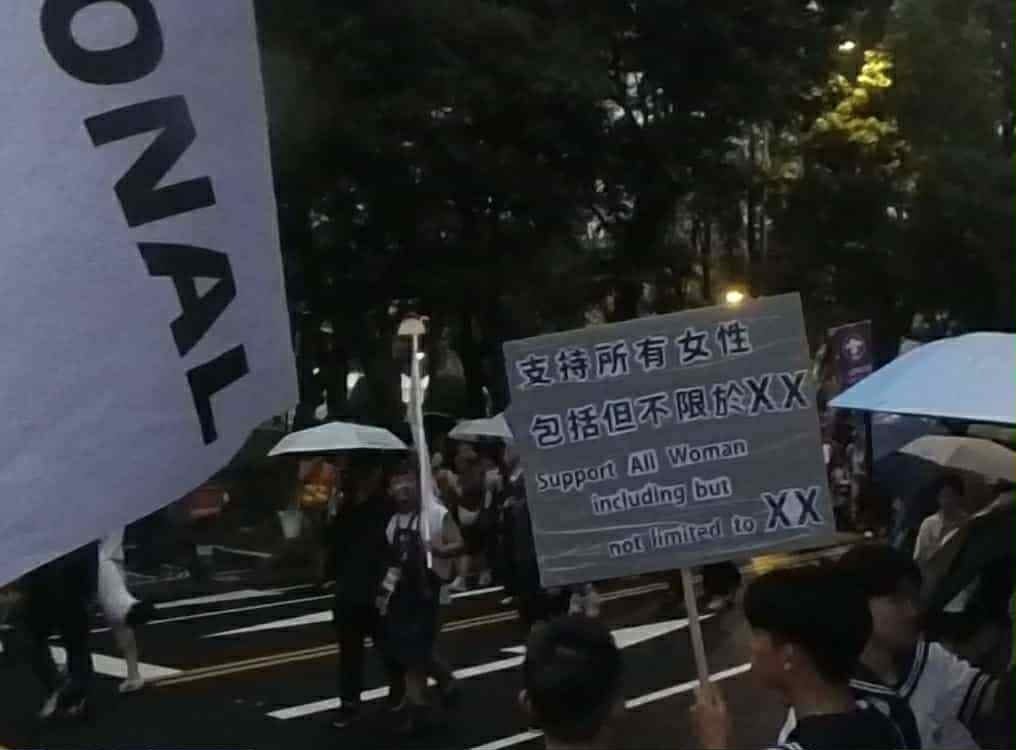
Some casual misogyny at Taiwan Pride, while following and harassing the LGB Alliance members.
A march amid an online storm
This year’s Pride, held on October 25 under the theme “Hyperlink: Cross labels, understand differences”, was Taipei’s largest civic celebration since the same-sex marriage law took effect in 2019. Despite steady rain, turnout swelled well into six figures, according to organizers and international coverage.
But the festival unfolded after weeks of unusually vicious public infighting within Taiwan’s broader LGBT+ advocacy ecosystem, triggered by comments from a Pride staffer that were criticized as “anti-transgender”. Belle Chiu, the public relations director of the Taiwan Rainbow Citizen Action Association, which organizes the LGBT Pride Parade, stated on her personal social media that she personally “opposes pedophilia, opposes surrogacy, and opposes gender identity fraud (legal changing of one’s sex-marker on documentation)”.
This deeper, politically sensitive dispute emerged around Taipei Pride’s Rainbow Declaration, Taiwan’s localized six-color interpretation of the traditional Pride flag. Historically, the declaration framed “red” as advocating for sexual rights and the removal of Criminal Code Article 221, which criminalizes rape and non-consensual sexual acts:
Article 221: “A person who by threats, violence, intimidation, inducing hypnosis, or other means against the will of a male or female and who has sexual intercourse with such person shall be sentenced to imprisonment for not less than three years but not more than ten years.”
(Ministry of Justice, ROC; an attempt to commit the offense is also punishable.)
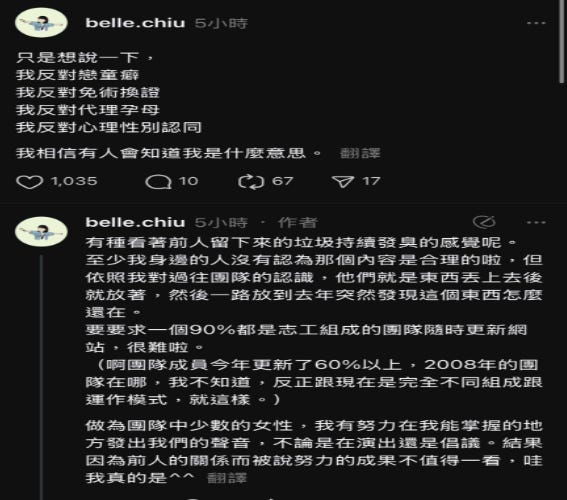
Chiu served as the director of public relationship for 2025 Taipei Pride before she spoke against the mainstream opinions of Taiwanese gay men. She states here that she opposes pedophilia, gender self-ID, surrogacy, and mental genders/gender identities. She defined Taiwan’s version of Rainbow Declaration as “stinking garbages left by former people” (Taipei Pride hosts).
According to LGB Alliance Taiwan, Pride organizers quietly removed the anti-221 language from their website after a public scandal surrounding Taiwanese celebrity, Mickey Huang, who was accused of involvement in consuming child pornography. Critics within the LGB community say the deletion was an attempt to downplay conversations about sexual-abuse prevention, grooming, and safeguarding.
The LGB Alliance Taiwan further alleges that LGBTQ+ institutions reinstated the declaration only after pressure from what they describe as “powerful older gay men”, a claim they have linked to long-standing conversations about predatory behavior and exploitation within some corners of Taiwan’s gay male community. LGB Alliance Taiwan states it is “the only LGB group willing to talk openly about the pedophile problem among gay men,” referencing a 2023 article on its own site detailing alleged cases and community responses.
Some activists, including one gay man cited by the group, described Pride organizers’ willingness to remove and restore the article as “ASPD behavior” (antisocial personality disorder), questioning why anyone would advocate weakening sexual-assault laws.
Those remarks prompted formal statements from established NGOs, media scrutiny and calls for clearer positions on sex-marker reform laws being pushed through in Taiwan. The Pride organizers apologized and reassigned the Chiu ahead of the march.
Into that volatile backdrop stepped LGB Alliance Taiwan.
“Increased threats and hostility” reported by LGB Alliance Taiwan
Following Pride weekend, LGB Alliance Taiwan says members saw a spike in threatening or doxxing-adjacent messages across multiple platforms, including posts naming individual volunteers. The group argues it is being punished for its public stance that same-sex attraction is defined by biological sex, not gender identity, an outlook that puts it at sharp odds with every established LGBT+ organization in Taiwan. .
LGB Alliance Taiwan was founded in 2024 by two activists, Nick Yao and Joan Lu. They describe their mission as re-centering lesbian, gay and bisexual advocacy on sex-based rights after, in their view, local NGOs moved toward a unified LGBTQ+ model that deprioritized LGB-specific issues. Their website echoes that position and frames the group’s work around L, G and B constituencies. Many LGB Alliance members can be described as “first-generation” gay and lesbian activists who participated in the gay rights movement’s earliest equality campaigns.
In fact, in recent years, many major LGBTQ+ organizations in the West shifted from a sex-based framework toward policies centered on gender identity, a change that critics say left little room for those who maintain that sexual orientation is rooted in biological sex. Individuals and groups who questioned this shift were frequently labeled “exclusionary,” and in some cases accused of bigotry or even extremism. Many lesbians and gay men argue that openly stating same-sex attraction has become socially discouraged in parts of the movement, particularly at Pride events, where they say such expressions are now treated as insensitive or politically unwelcome. For these critics, the irony is stark: a community once fighting for the right to name and live their sexuality now faces pressure to soften or silence that same reality in the name of progress.
The LGB Alliance Taiwan argues that much of the country’s (Taiwan) LGBT+ sector is now led by, and primarily oriented toward, gay men, leaving lesbian concerns underrepresented in policy discussions. As part of its stated mission to refocus attention on sex-based rights, the alliance has submitted a formal opinion to Taiwan’s CEDAW committee asserting that protections for women should be grounded in biological sex. Members say this stance reflects their view that lesbians and bisexual women are among the first groups affected by gender self-identification policies, and that their organization fills a gap left by larger NGOs that, in their view, have deprioritized lesbian-specific issues.
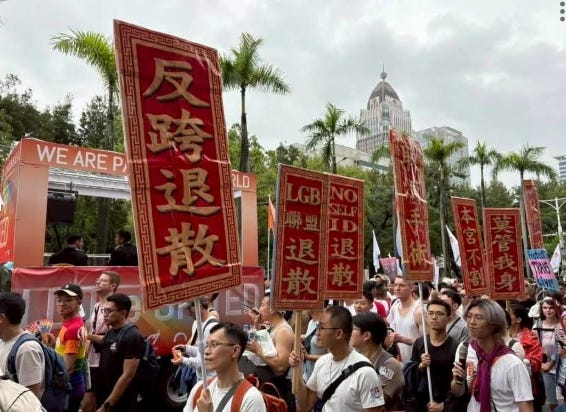
Signs say (from left to right): Transphobes go away, No Self ID website go away, LGB Alliance go away, Cancel (gender) surgery, We trans women do not cut off our penises, You have no power over my body, 100 strokes of the cane for Ministry of the Interior (for not passing the self-ID bill.)
In September 2025, national LGB Alliance groups from 17 countries launched LGB International, a global umbrella aimed at coordinating advocacy and representing LGB positions before multilateral institutions. The UK-based LGB Alliance, founded in 2019, announced the launch and described LGB International’s remit as supporting national affiliates, sharing resources and providing a global voice for same-sex-attracted people.
The UK parent organization’s stated mission includes advancing LGB rights, highlighting the “dual discrimination” faced by lesbians, and safeguarding children who may grow up LGB.
What happened on the ground at Pride
In practice, the march featured a mix of corporate teams, rights groups and political parties, and, this year, a visible debate over trans rights that spilled from social media into streetside chants and placards.
Against that scene, Yao’s account details hours of being followed by a rotating cluster of counter-demonstrators shouting or filming at close range. Bystanders captured some of the back-and-forth; Yao wore a body camera that captured heated verbal exchanges. According to Yao, ”we were surrounded by them. But one thing that stood out was, at around the last one-third of the route, a trans-activist (with a megaphone) showed up and started blasting at us with “This is a hate/transphobic organization !” The host of the Taipei Pride event even called the organization (LGB-A) a “fake gender equality group” on the main Pride stage.

Waiting for LGB-A Taiwan members in front of the exit of Zhongxiao Dunhua station, in Taipei, with trans flags in their hands. They followed Yao for a majority of the parade route, he says.
Taiwan’s Pride has long symbolized the island’s pluralism. Advocates note that the tensions seen in Taipei echo patterns already documented in the UK, Europe and Australia, where LGB-focused groups have reported harassment and online intimidation for advancing sex-based rights and critiquing gender-identity policies. Analysts say Taiwan is not an outlier but part of a wider global dispute over who defines the boundaries of LGBT advocacy, and who is permitted to speak within it. For members of LGB Alliance Taiwan, the hostility they encountered at this year’s Pride is less an isolated incident than the local expression of a familiar international trend: sustained pressure on organizations that depart from gender-identity orthodoxy in favor of sex-based human-rights frameworks.
As LGB Alliance Taiwan seeks legal recognition and a larger footprint, skirmishes like those described by Yao are likely to recur, online and offline.
Visit them at: https://www.lgballiance.tw/
 Jaclynn Joyce