Taiwan’s High Court handed down a verdict that should haunt anyone who takes violence against children seriously
Thank you for all the new followers and shares! I am using Substack a lot more than WordPress, so make sure to subscribe (it’s free!)
On November 25, 2025, Taiwan’s High Court handed down a verdict that should haunt anyone who takes violence against children seriously.
Former television host Mickey Huang was sentenced to one year and six months in prison, suspended for four years, for possessing sexual images and videos involving 37 minors aged 10–17. He is required to complete 180 hours of labor service and three legal education sessions. The sentence can still be appealed, but unless something dramatic changes, he will not serve a single day in prison.
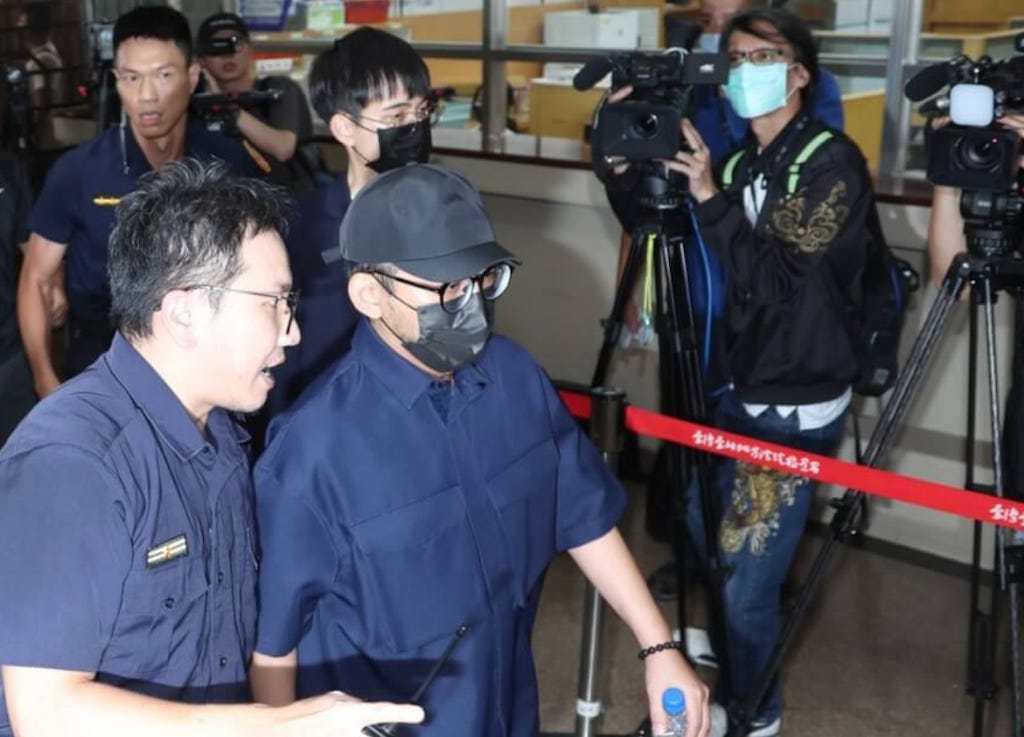
Mickey Huang is taken in for police questioning, 2023. (CNA photo)
According to the court, Huang joined an online forum called Creative Private House in 2014 and used it to purchase and store these images of child sexual abuse, keeping them for years, even after amendments to the Child and Youth Sexual Exploitation Prevention Act (CYSEPA) came into force in 2023.
The court acknowledged that he violated CYSEPA and the Personal Data Protection Act, and noted that he had settled with 37 victims. On that basis, with no prior criminal record and “settlements reached”, the judges granted him a suspended sentence.
Women’s rights groups and child-protection NGOs immediately condemned the ruling as a failure to understand the gravity of digital sexual violence. ECPAT Taiwan said that granting a suspended sentence solely because settlements were reached is “completely contrary” to the spirit of laws designed to protect minors.
Now set that beside another decision.
In 2023, a Taiwanese court sentenced a man to five years and six months in prison for growing marijuana and making cigarettes, cream and chocolate from it. Cannabis is classified as a Category II narcotic in Taiwan; cultivating or processing it for distribution is treated as a major crime.
So, to clarify for my readers, a man who grows a plant and turns it into weed products gets 5.5 years in prison.
A famous entertainer who buys and stores sexual images of 37 children gets a suspended sentence and some community service.
If you want a concrete picture of Taiwan’s moral priorities, you don’t need a philosophy seminar. You just need to read the court records.
A Country Obsessed With “Drugs,” Indifferent to Predators
Under Taiwan’s Narcotics Hazard Prevention Act, cannabis is classified as a Category II narcotic. Using cannabis carries a maximum penalty of three years in prison; possessing it can lead to up to two years in prison, detention, or a fine, with harsher penalties if the quantity is large or if there is intention to sell.
Manufacturing, transporting, or selling Category II narcotics (including cannabis) can result in life imprisonment or a minimum ten-year term, plus fines of up to NT$15 million.
The government proudly advertises this harshness. Official advisories warn Taiwanese travelers never to carry cannabis products back from places like Thailand or Canada, because they could face years behind bars.
In 2023 alone, police seized a record 1,169.3 kilograms of cannabis products and nearly 6,700 plants, and 802 people were charged with marijuana use or possession. Premier Chen Chien-jen publicly urged agencies to “work harder” to crack down.
On drugs, the moral panic is clear. The state wants us to believe that cannabis is such a grave threat that it justifies multi-year sentences and public crusades.
Digital Sexual Violence: The “Tip of the Iceberg”
The Huang verdict is not an isolated case, but the visible tip of a much deeper problem.
In 2024, Taiwanese police dismantled what was described as the largest illegal pornography ring in the country’s history, involving hundreds of people and an online ecosystem where child sexual abuse images and voyeuristic footage of women were traded, often paid for in cryptocurrency.
Local reports noted that possession of child sexual abuse images only became explicitly criminalized in Taiwan in 2023, astonishingly late, given international standards. NGOs like the Taipei Women’s Rescue Foundation have been calling for stiffer penalties for those who obtain such images, not only those who create or distribute them.
In the Huang case, we learned that the “Creative Private House” forum had over 5,000 members, including police officers and teachers, the very people we trust to protect children.
Let that sink in.
Teachers and police officers were among thousands of men trading images of children being sexually abused.
A lawyer representing one of the victims bluntly stated that the case shows how inadequate current laws are for deterring digital sexual violence.
Legislators themselves have acknowledged that Taiwan’s laws are too lenient on child and sex crimes, with public outcry mounting as cases like Huang’s surfaced even before his final conviction.
If this does not feel like a national emergency, it should.
This isn’t a legal technicality; it is a reflection of political priorities. Taiwan inherited decades of anti-drug moral panic, where being “tough on drugs” is good politics, while confronting sexual crimes, especially those involving powerful men, is treated as messy, embarrassing, and socially inconvenient. Victims are pressured to settle. Courts cite apologies and payments as mitigating factors. And predators in esteemed professions are quietly shielded.
If Taiwan truly wants to protect children, meaningful reform must begin with one principle:
No suspended sentences for large-scale possession of child sexual abuse materials.
Settlements shouldn’t purchase freedom. Celebrity shouldn’t soften consequences. And cannabis use, already legalized or decriminalized in much of the world, should not trigger harsher punishment than consuming images of children being raped.
Laws reveal what a society fears most. Right now, Taiwan fears a cannabis edible more than it fears men who create demand for the sexual exploitation of minors. Until that changes, every victim is being told exactly how much their suffering is worth.
Jaclynn is a Taiwan-based writer and activist exposing the gap between law and lived reality for women and children. She writes on sex-based rights, digital exploitation, and political hypocrisy.
 Jaclynn Joyce